
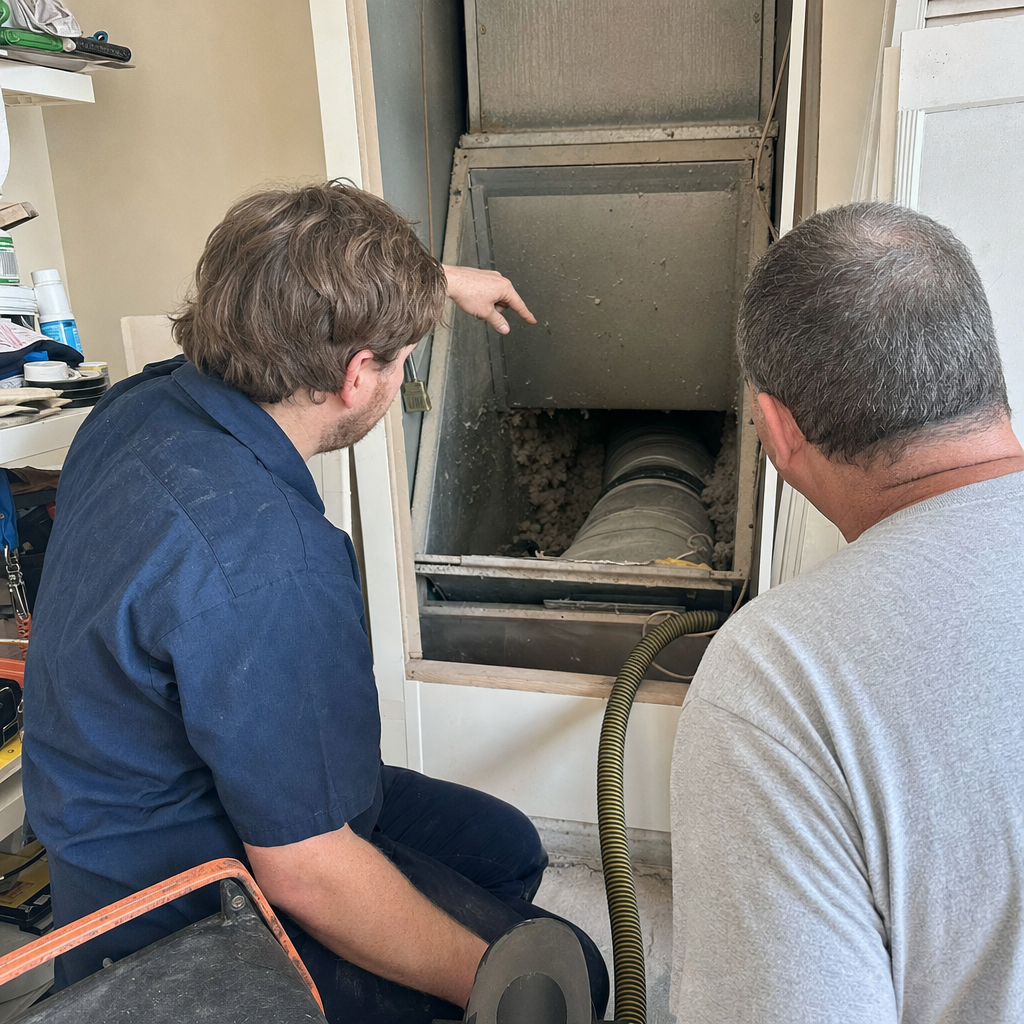
Is Air Duct Cleaning Worth It in Virginia, VA? Three Scenarios Where It Helps — and Two Where It Doesn’t
Air duct cleaning is worth it when there’s verifiable contamination in your system: post-renovation debris, visible mold or rodent intrusion, or heavy dust accumulation after 5+ years without cleaning in a home with pets or high occupancy. It’s not worth it if your ducts were recently cleaned, if your real problem is a clogged HVAC filter or dirty evaporator coil, or if moisture intrusion hasn’t been fixed first. In Virginia’s humid climate, we see a lot of cases where musty odors get blamed on ducts when the actual culprit is crawlspace vapor or a fouled coil — and cleaning ducts alone won’t solve those. For a full breakdown of what comprehensive service runs, see our Whole House Air Duct Cleaning Cost in Virginia, VA. If you’re unsure which situation you’re in, call us at (844) 668-1229 and we’ll tell you straight.

Virginia’s coastal humidity shapes everything about how HVAC systems age here. Summers in Hampton Roads hang above 80% relative humidity for weeks at a stretch, and that moisture finds its way into crawlspaces, attic plenums, and duct seams. We’ve worked in Norfolk’s Larchmont neighborhood where 1920s pier-and-beam construction creates chronic vapor pressure problems, and in Virginia Beach’s newer Sandbridge builds where tight envelopes trap humidity unless the ventilation is precisely balanced. The housing stock varies enormously — from century-old bungalows near Old Dominion to townhome clusters around Town Center — and so does the condition of what’s inside the ducts. That’s why Ronald Cooper, our owner and lead technician, starts every assessment the same way: he wants to see what we’re actually dealing with before he runs a brush.
When Air Duct Cleaning Is Genuinely Worth the Investment
Over 11 years, we’ve identified three situations where professional duct cleaning produces measurable, documentable improvement in system performance and indoor air quality. These aren’t marketing categories — they’re what we find when we open access panels and look.
Post-Renovation Dust Contamination
Drywall dust is insidious. It migrates through return vents during construction, settles in duct trunks, and recirculates for months after the contractors leave. We’ve pulled pounds of it from systems in Ghent and Chelsea after kitchen remodels where the HVAC was running during demo. The particulate is fine enough to pass through standard filters and abrasive enough to accelerate blower motor wear. If you’ve had significant interior work done and the system was active, cleaning is worth it — and we typically recommend it within 30 days of project completion before the dust fully compacts.
Verified Mold or Rodent Intrusion
Virginia’s humidity creates mold-friendly conditions in ductwork with any air leakage to unconditioned spaces. We find it most often in flex duct runs through hot attics, where temperature differentials cause condensation on the exterior that wicks inward at seams. Rodent intrusion is more common in crawlspace ductwork, particularly in older Norfolk neighborhoods where field mice follow utility penetrations. In both cases, cleaning without remediation is incomplete — but cleaning with proper containment (we use Abatement Technologies HEPA filtration during the process) is essential to removing the biological load.
Visible Debris Accumulation on Neglected Systems
The EPA’s threshold is roughly right: systems that haven’t been cleaned in 5+ years, particularly with pets or high occupancy, accumulate enough debris to measurably restrict airflow. We’ve photographed supply registers in Virginia Beach ranch homes where the grille fins were caked with a felt-like mat of hair, skin cells, and lint. That restriction forces the blower to work harder, extends run times, and can imbalance room-to-room airflow. Our Rotobrush system with HEPA extraction removes this accumulation without dislodging it into living spaces — a risk with inadequate equipment.
- Post-renovation: Drywall and construction particulate that bypassed filters
- Biological contamination: Mold growth or rodent debris requiring containment-grade removal
- Mechanical restriction: Visible debris reducing airflow after 5+ years without service
When Air Duct Cleaning Is Not Worth Your Money
This is where most competitors go quiet. We’re not going to. There are legitimate scenarios where we’d rather tell you to spend elsewhere — because a technician who always recommends cleaning is optimizing for their schedule, not your outcome.
Recently Cleaned Systems
If your ducts were professionally cleaned within the past 2-3 years and you’ve changed filters regularly, there’s rarely enough new accumulation to justify the cost. We decline repeat business in these cases. The exception is if you’ve had a major environmental event — flooding, smoke damage, new construction — since the last cleaning.
Filtration or Coil Problems Masquerading as Duct Issues
This is the most common misdiagnosis we see in Virginia. A homeowner calls complaining of dust, mustiness, or poor airflow, and the assumption is ducts. Often, the real problems are:
- Wrong filter type or infrequent changes: A MERV 8 pleated filter changed every 90 days catches dramatically more than a cheap fiberglass panel changed annually
- Fouled evaporator coil: Virginia’s humidity breeds microbial growth on coils, producing musty odors that distribute through ducts — but the ducts themselves are clean
- Crawlspace vapor infiltration: In pier-and-beam construction common from Norfolk to Portsmouth, unsealed crawlspaces pump humid, sometimes moldy air into floor cavities. Duct cleaning doesn’t touch this source
Ronald Cooper handles your job personally — owner on-site, not an oversight call away. When we assess a system, we check the coil, the filter, and the building envelope pressure dynamics before we recommend duct cleaning. We’ve told more than one homeowner in Virginia Beach to spend $200 on a coil cleaning and better filters rather than $600 on ducts they didn’t need. “If I can show you what I found, you can decide what it’s worth fixing.” That’s how we work.
Unresolved Moisture Intrusion
Cleaning mold-contaminated ducts without fixing the moisture source is temporary at best and potentially misleading at worst. We’ve seen crawlspace flex duct with chronic condensation from poor insulation — clean it, and the mold returns in 6-18 months. The honest assessment identifies the source first.
What the EPA Actually Says About Duct Cleaning
Most service pages gloss over this because it complicates the pitch. The EPA’s position is nuanced, and it’s worth getting right:
The EPA does not recommend routine air duct cleaning as preventive maintenance. They state that “duct cleaning has never been shown to actually prevent health problems” and that “no research conclusively demonstrates that particle levels in homes increase because of dirty air ducts.” However, they do recommend cleaning in specific circumstances: visible mold growth, infestation by rodents or insects, and excessive dust/debris release from supply registers.
This aligns exactly with our experience. The value isn’t in the calendar — it’s in the condition. A home with no pets, no renovations, regular filter changes, and no moisture problems doesn’t need duct cleaning every two years. A home with three shedding dogs, a 2019 kitchen remodel where the contractor ran the AC during demo, and flex duct in a humid crawlspace? That’s a different assessment.
What an Honest Duct Assessment Actually Looks Like
When Ronald Cooper arrives for an evaluation — and he arrives personally, not a trainee with a checklist — here’s what he examines before recommending any service:
| Inspection Point | What We’re Looking For | What It Tells Us |
|---|---|---|
| Supply register debris load | Visible accumulation on fins and in boot | Whether particulate is actively distributing into living space |
| Air handler condition | Coil fouling, blower wheel buildup, drain pan status | Whether the problem originates upstream of ducts |
| Renovation/flooding history | Timeline of interior work or water damage | Whether contamination events occurred post-last-cleaning |
| Filter maintenance record | Type, MERV rating, change frequency | Whether filtration failure caused or accelerated duct loading |
| Building envelope and duct leakage | Crawlspace vapor, attic duct insulation, seam integrity | Whether moisture or unfiltered air is re-contaminating cleaned ducts |
This diagnostic takes 20-30 minutes. We don’t charge for it — because we’d rather earn your trust with an honest no than lose it with an unnecessary yes. Nearly 1,000 verified reviews at 4.9 stars — look them up before you book. That volume reflects a lot of homeowners who appreciated getting the straight answer.
What Professional Duct Cleaning Costs in Virginia — and What Affects the Price
Pricing varies with system size, accessibility, and contamination level. For a detailed breakdown, see How Much Does Air Duct Cleaning Cost? (2026 Price Guide) — Virginia, VA. Below are the ranges we see for legitimate, equipment-serious work in the Hampton Roads market. Beware coupon offers below these ranges — they typically involve minimal contact time, inadequate containment, or shop-vac-level equipment that doesn’t achieve source removal.
| Service Scope | Typical Virginia Market Range | What Drives Cost |
|---|---|---|
| Residential duct cleaning (single system, up to 12 vents) | $400 – $700 | Vent count, system accessibility, contamination level |
| Larger home or dual-zone system | $700 – $1,100 | Additional trunk lines, zone dampers, attic/crawlspace routing |
| With HVAC coil and blower cleaning | Add $150 – $300 | Coil accessibility, degree of fouling, chemical treatment needs |
| With sanitizing treatment (Guardsman or equivalent) | Add $75 – $150 | Application method, coverage area, post-treatment verification |
| Duct repair/sealing (separate service) | $200 – $600+ | Extent of leakage, material type, access difficulty |
We use Rotobrush and Nikro systems — the same equipment HVAC professionals trust — with HEPA containment that captures particulate rather than redistributing it. One company for cleaning, sealing, repair, and sanitizing — no referrals, no runaround. 11 years of duct work, zero sidelines — this is all we do.
How Virginia’s Climate Specifically Affects Your Ductwork
The local details matter for whether cleaning is worth it. In Virginia Beach’s oceanfront zone, salt air accelerates corrosion on metal duct components and can degrade flex duct outer wraps. Inland in Chesapeake and Suffolk, clay soils shift seasonally, stressing slab-duct connections in older ranches. Norfolk’s historic districts have original plaster-and-lath walls with chases that weren’t designed for modern HVAC — retrofit ductwork often has sharp turns and low velocity that promote deposition.
Humidity is the constant. From June through September, dew points in Hampton Roads routinely hit 70°F+. Any duct leakage to unconditioned space draws that moisture inward. We’ve found mold growth in attic plenums where the homeowner’s only symptom was “the house smells different in summer” — the ducts were clean, but the plenum was compromised. That’s why our assessments include the full air distribution path, not just the visible runs.
FAQs
Every 5-7 years for typical residential systems with regular filter maintenance — sooner if you have multiple pets, recent renovations, or visible contamination at registers. Not sure about your home? See our guide on how often to clean air ducts in Virginia, VA. Virginia’s humidity can accelerate biological growth, so we recommend more frequent inspection (every 2-3 years) even if cleaning isn’t always needed. Call (844) 668-1229 if you’re unsure where your system falls.
Cleaning is almost always more affordable — typically $400-$700 versus $2,000-$5,000+ for partial replacement — but replacement becomes necessary when ducts are deteriorated, improperly sized, or extensively contaminated beyond what cleaning can safely address. We evaluate this honestly during assessment; we’ve recommended replacement for flex duct in flooded Virginia Beach crawlspaces where cleaning would have been a waste. For an exact evaluation of your system, call (844) 668-1229 — estimates are free.
Dirty ducts can aggravate allergies and asthma by recirculating accumulated particulate, but they rarely cause illness directly in otherwise healthy individuals — the EPA confirms no proven link to serious disease. The greater concern in Virginia’s climate is mold or rodent contamination, which can produce genuine health effects and requires professional containment-grade removal. If you suspect biological contamination, call (844) 668-1229 for a same-week assessment.
Check your filter first — if it’s clogged, the wrong MERV rating for your system, or hasn’t been changed in 6+ months, that’s likely your culprit. Next, remove a supply register and look inside with a flashlight: visible debris accumulation means ducts; minimal debris with persistent dust issues suggests filtration or coil problems. Ronald Cooper, our owner and lead technician, diagnoses this distinction on every assessment — we use Rotobrush and Nikro systems only when the source is actually in the ducts. Call (844) 668-1229 and we’ll tell you which problem you actually have.
Key Takeaways
- Air duct cleaning is worth it when there’s verifiable contamination — post-renovation debris, mold/rodent intrusion, or heavy accumulation after years of neglect
- It’s not worth it for recently cleaned systems, filtration/coil problems misdiagnosed as duct issues, or unresolved moisture sources
- Virginia’s humidity and varied housing stock mean assessments must include building envelope and HVAC components, not just duct runs
- Owner-operator accountability and professional equipment (Rotobrush, Nikro, Abatement Technologies) separate legitimate service from coupon-grade work
If you’d rather have it looked at, Anchor Air Duct Cleaning Service Virginia offers a no-pressure assessment in Virginia — call (844) 668-1229. Ronald Cooper handles your job personally, and if we don’t think cleaning is worth your money, we’ll tell you exactly that.
Written by Ronald Cooper, Owner & Lead Technician at Anchor Air Duct Cleaning Service Virginia, serving Virginia, VA.