
How Often Should You Clean Air Ducts in Virginia? It Depends on What Your System Is Actually Dealing With
Most homes in Virginia need professional air duct cleaning every 3 to 5 years, but that interval collapses to 1 to 2 years — or even sooner — if you have shedding pets, recent renovation work, occupants with allergies or asthma, or a crawlspace duct system pulling in humid coastal air. The honest answer isn’t a calendar date — which is why homeowners often ask Is Air Duct Cleaning Worth It? (Virginia, VA) — it’s a set of conditions specific to your house, your habits, and your local environment. If you want a straight assessment of where your system stands, call Anchor Air Duct Cleaning Service Virginia at (844) 668-1229 — we’ll look at your actual ductwork and tell you what we see, no pressure.

Why the “Every 3 to 5 Years” Rule Falls Short for Virginia Homes
That standard timeline works fine for a hypothetical house in a hypothetical climate. It doesn’t account for the reality of Hampton Roads construction, our pollen load, or the way many Virginia Beach and Norfolk homes pull return air through crawlspaces that stay damp eight months of the year.
Ronald Cooper, Owner & Lead Technician at Anchor Air Duct Cleaning Service Virginia, has spent 11 years inspecting duct systems across the region — from the century-old bungalows off Colley Avenue in Norfolk to the newer townhome clusters in Virginia Beach’s Princess Anne corridor. The variation in what he finds is enormous. Two houses built in the same year, same neighborhood, can have ducts that look nothing alike inside.
The difference comes down to five factors we check on every initial assessment:
- Pet shedding load: A single Labrador in a 1,500-square-foot ranch produces enough dander and hair to visibly coat register boots within 18 months. Multiple pets compress that further.
- Recent renovation activity: Drywall dust, sawdust, and fiberglass particles bypass standard filters and settle in ductwork permanently without professional extraction.
- Filter maintenance discipline: A MERV 8 filter changed every 30 days catches roughly 70% more particulate than the same filter pushed to 90 days — and we’ve opened systems where the filter was essentially a solid mat.
- Crawlspace vs. basement returns: Ducts drawing return air through a vented crawlspace in Virginia’s humidity pull in mold spores, insect debris, and fine soil particles that basement-return systems never see.
- Occupant respiratory sensitivity: Homes with asthma or allergy sufferers benefit from tighter intervals because the cost of accumulated particulate is measured in health outcomes, not just system efficiency.
These aren’t abstract concerns. In spring 2023, Ronald cleaned a system in the Larchmont-Edgewater area of Norfolk where the homeowner had followed the 3-year rule religiously — but they’d also finished a basement renovation 14 months prior, run a Golden Retriever, and changed filters roughly twice a year. The supply boots were caked with a gray paste of drywall dust and pet dander that a standard interval completely missed. That’s the scenario we’re trying to prevent with a condition-based framework instead of a calendar guess.
Virginia’s Pollen Season: A Real Factor in Duct Accumulation
The Virginia Department of Environmental Quality consistently ranks our spring pollen counts among the highest on the East Coast. Oak, pine, and birch release simultaneously here in a compressed window from late March through early May, and the particulate load is genuinely different from what you’d see in, say, coastal New England or the upper Midwest.
Here’s what that means practically: homes with loose duct connections, aging flex duct in attics, or high air-exchange rates pull more outdoor particulate into the system during this window. We’ve opened ductwork in late May that had a visible yellow-green film on the interior surfaces — pollen that made it through the filter, settled in the ducts, and became a year-round reservoir every time the blower kicked on.
The homes most affected tend to be:
- Pre-1990 builds with original metal ductwork and unsealed joints
- Houses with attic-mounted air handlers and flex duct runs that have loosened at connections
- Properties near the Chesapeake Bay or its tributaries, where higher humidity keeps pollen particulate adhesive longer
If your household includes someone with seasonal allergies that seem to extend well past May, your ductwork may be recirculating captured pollen. That’s a condition that justifies inspection regardless of when you last cleaned.
The Filter Factor: How Your Habits Change Everything
This is the single most underappreciated variable in duct cleaning frequency, and it’s the one you control directly.
A homeowner in the Kempsville area of Virginia Beach called us last year convinced her ducts were “due” at the 4-year mark. Ronald pulled a supply register and found the boot nearly clean — unusual for that interval. The reason: she’d set a phone reminder and changed her MERV 11 filter every 25 days without fail. Her ducts weren’t dirty because her filter was doing the work.
Conversely, we’ve opened systems in the Ocean View neighborhood where the filter was so overloaded it had bowed into the return, creating a bypass gap that let unfiltered air run for months. Those ducts were packed at 2 years.
The practical framework we use:
| Filter Type | Change Interval | Typical Duct Cleaning Extension |
|---|---|---|
| MERV 8, changed monthly | 30 days | Can push toward 5-year interval if no other factors |
| MERV 8, changed quarterly | 90 days | Standard 3-year interval |
| MERV 11-13, changed monthly | 30 days | Often extends interval, but monitor filter life — high MERV loads faster |
| Filter ignored or “when I remember” | Variable | Inspect at 2 years; likely needs cleaning regardless of calendar |
We’re not here to sell you filters. We’re telling you this because Ronald has watched the same house, same duct system, need cleaning at radically different intervals based entirely on what the homeowner did or didn’t do with a $15 disposable.
Post-Renovation: The Hard Trigger That Overrides Every Schedule
If you’ve had drywall work, flooring replacement, or significant carpentry done in the past 12 months, your ducts are almost certainly carrying construction debris. This is non-negotiable in our assessment protocol.
Drywall dust is 3 to 5 microns — fine enough to pass through standard fiberglass filters and electrostatically adhere to duct interiors. Once it’s in there, your blower recirculates it continuously. We’ve cleaned systems where the homeowner had renovated a single bathroom six months prior and the supply duct serving that wing was coated white. They’d been breathing it since completion.
The same applies to older homes in Ghent or Freemason where lead paint abatement or plaster repair was part of the work. Those particulates are not neutral. If renovation occurred and your ducts weren’t isolated during construction, inspection is warranted regardless of your last cleaning date.
Our Air Duct Cleaning process uses Rotobrush and Nikro extraction systems — the same equipment HVAC professionals use for post-construction cleanup — because consumer-grade shop vacuums simply don’t generate the sealed suction and agitation needed to remove settled fine particulate.
Ronald’s Field Test: Look at the Boot, Not the Calendar
After 11 years of opening registers, here’s the practical benchmark Ronald uses when a homeowner asks “are my ducts actually dirty?”
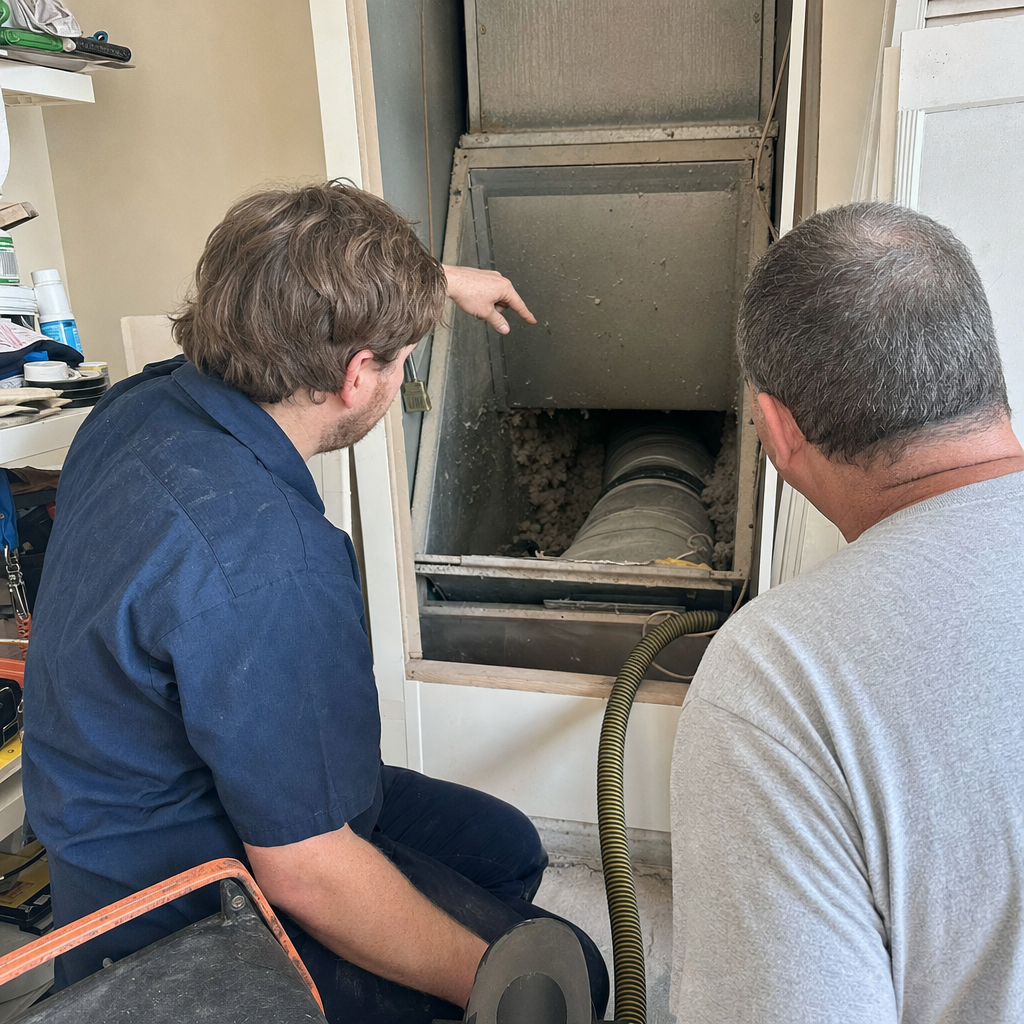
Pull a supply register cover — the vent where heated or cooled air enters your room — and shine a flashlight down the boot, the short duct section behind the grille. If you see a visible layer of debris on the bottom surface, you’re past due. It doesn’t matter if you cleaned 2 years ago or 6. That visible accumulation is already being recirculated.
The boot is the canary because it’s the lowest point in the supply run; gravity concentrates what the blower hasn’t yet lifted. If it’s clean, your main trunk lines are probably acceptable. If it’s coated, the trunk lines are worse — they’re just harder to see without a scope.
If I can show you what I found, you can decide what it’s worth fixing. That’s how we approach every assessment. We’re not going to tell you a system needs cleaning when the boots are clean; we’ve walked away from jobs where the ducts were genuinely fine and the homeowner just needed filter guidance.
Common Local Scenarios We See Across Virginia
These are real patterns from our work, not marketing archetypes. See which matches your situation:
The First-Time Buyer in a 1970s Ranch
Common in neighborhoods like Lakewood in Norfolk or parts of Green Run in Virginia Beach. Original metal ductwork, maybe one prior cleaning if any, often a single return pulling through a vented crawlspace. These systems typically need initial cleaning at acquisition — you have no maintenance history — then can settle into a 4-year rhythm with good filter habits.
The Renovation-Heavy Household
Flippers, serial improvers, or recent buyers updating kitchens and baths. If you’ve had three rooms of work in two years, your ducts have seen more debris than a 10-year static household. We recommend inspection after any major drywall phase, not at some arbitrary future date.
The Multi-Pet Family with Allergies
Two cats, a dog, and a child with asthma. This combination compresses interval to 18 to 24 months reliably, and we often pair cleaning with our air sanitizing service using Guardsman-treated solutions to reduce biological loading. The ducts aren’t just dirty — they’re carrying dander that standard cleaning alone won’t fully neutralize.
The “We Never Thought About It” Property Manager
Rental units in Virginia Beach’s resort zone or Norfolk’s student housing areas. Tenants don’t report duct issues; they just run the system harder. We find filters unchanged for a year-plus and ducts that haven’t been cleaned in a decade. For multi-unit properties, we recommend inspection at every tenant turnover — it’s cheaper than HVAC strain complaints or health-related liability.
What Professional Duct Cleaning Actually Involves — And Why Equipment Matters
When you do reach the point of cleaning, Whole House Air Duct Cleaning Cost in Virginia, VA varies enormously by who’s doing it and what they’re running.
Franchise crews rotating new technicians through your house with portable shop vacuums and a brush on a drill are not performing the same service we do. Ronald Cooper handles your job personally — owner on-site, not an oversight call away — and the equipment lineup reflects that seriousness.
Our standard residential cleaning deploys:
- Rotobrush brush-and-vac systems for supply and return line agitation with simultaneous negative-pressure extraction
- Nikro portable HEPA collectors for contained debris removal — nothing exhausted into your living space
- Abatement Technologies air scrubbers run during the job to capture any fugitive particulate
The process takes 3 to 5 hours for a typical 2,000-square-foot home because we’re cleaning every accessible run, not just the trunk lines and a few registers. We also inspect for disconnected ducts, crushed flex runs, and seal gaps that are pulling unfiltered air — because cleaning a leaky system is temporary at best.
Nearly 1,000 verified reviews at 4.9 stars — look them up before you book. That volume reflects consistent execution across hundreds of real Virginia homes, not a handful of cherry-picked testimonials.
FAQs
Most Virginia homes need cleaning every 3 to 5 years, but Affordable Air Duct Cleaning in Virginia, VA is often needed every 1 to 2 years for homes with pets, recent renovations, crawlspace returns, or allergy-sensitive occupants. Our heavy spring pollen season and coastal humidity accelerate accumulation compared to drier inland climates. Call (844) 668-1229 for a free assessment of your specific conditions — we’ll look at your boots and tell you what we see.
No — deferred cleaning typically costs more because accumulated debris strains your HVAC blower, shortens equipment life, and can require more intensive remediation if mold or pest debris develops. We’ve cleaned systems where a 7-year interval turned a $400 standard job into an $800 deep restoration because the particulate had compacted and required multiple agitation passes. Regular intervals protect both air quality and equipment investment.
Diligent filter changes extend cleaning intervals significantly but don’t eliminate the need entirely. Filters catch what passes through them; they don’t remove what’s already settled in ductwork, and they can’t address debris introduced during renovations or pulled in through duct leaks. Think of filters as prevention and cleaning as remediation — both have a role.
Check the supply boots with a flashlight 30 days after service — if they’re already accumulating debris, the prior cleaner likely didn’t reach the full run or used insufficient agitation. A proper Rotobrush or Nikro cleaning with negative-pressure extraction should leave ducts visibly clean at access points for at least a year. We document our work with before photos on request, and Ronald reviews every job personally before we leave the site.
When to Call for an Assessment
If you’ve read this far, you probably have a specific situation in mind — a renovation you finished, a filter you’ve been meaning to change, a family member whose allergies seem worse indoors. Rather than guessing at an interval, have someone look at the actual condition.
Anchor Air Duct Cleaning Service Virginia offers no-pressure inspections throughout Virginia, Norfolk, Virginia Beach, and surrounding Hampton Roads communities. Ronald Cooper will be the one who shows up, pulls a register, and tells you straight whether your ducts need work now, later, or not at all.
Call (844) 668-1229 to schedule, or visit our home page to learn more about our full range of Air Duct Cleaning in Virginia and related services.
Written by Ronald Cooper, Owner & Lead Technician at Anchor Air Duct Cleaning Service Virginia, serving Virginia, VA.