
How Much Does Duct Repair & Sealing Cost in Virginia Beach?
Duct Sealing Cost in Virginia, VA typically runs between $300 and $1,200 for a standard residential job, with most homeowners landing somewhere in the $450–$750 range depending on system size, accessibility, and the extent of the damage. Mastic sealing on a mid-size home with 10–15 supply and return vents usually runs in the lower half of that window, while full duct replacement sections or jobs involving crawl space access push toward the higher end. At Anchor Air Duct Cleaning, Ronald Cooper handles your assessment personally — so the number you get reflects what’s actually in your system, not a ballpark from someone who hasn’t looked.
Duct Repair & Sealing Cost Breakdown (2026)
These ranges reflect what Virginia Beach homeowners are realistically paying for our Duct Repair & Sealing services in 2026. Prices vary by contractor, system complexity, and access difficulty — but this table gives you a honest framework before you call anyone.
| Service | Typical Price Range | Notes |
|---|---|---|
| Mastic sealing (whole-home, accessible attic) | $350–$600 | Most common service in Virginia Beach homes built pre-2000 |
| Aeroseal duct sealing (pressurized injection) | $1,200–$2,500 | Seals from the inside; ideal when ducts aren’t easily accessible |
| Foil-tape sealing (joints and connections) | $150–$350 | Best for localized leaks at accessible registers or air handlers |
| Flex duct section repair or replacement | $200–$500 per section | Common in Virginia Beach crawl spaces where humidity degrades flex duct |
| Sheet metal duct repair (rigid) | $300–$800 per section | Labor-intensive; cost rises with access difficulty |
| Duct repair + full cleaning (combined job) | $550–$1,400 | Sealing after a cleaning protects the work and improves results |
| Crawl space duct repair (limited access) | $400–$900 | Virginia Beach’s salt-humid air accelerates duct joint failure here |
| Diagnostic/leak assessment | $75–$200 | Often credited toward repair if you proceed with the same contractor |
The single biggest variable in Virginia Beach isn’t square footage — it’s where the ducts live. Homes in Kempsville and Great Neck with attic systems are usually straightforward. Homes in Chesapeake-bordering neighborhoods like Creeds or Pungo with crawl space ductwork cost more because of access, and because years of coastal humidity have often done more damage than the homeowner realizes. Ronald Cooper has worked in both environments hundreds of times — when he quotes a job, he’s accounting for what he’s actually going to encounter, not an average.
If you want to pair repair with a Duct Repair & Sealing in Virginia service, doing both in a single visit is almost always more cost-effective than scheduling them separately — and it ensures newly sealed ducts aren’t trapping old debris inside.
What Affects Duct Repair & Sealing Pricing in Virginia Beach
- Duct location and accessibility: Attic ductwork in Virginia Beach homes from the 1980s and 90s is generally easier to reach and seal than the crawl space systems common in older Bayside or Lynnhaven-area neighborhoods. Tight crawl spaces drive labor time up significantly — sometimes doubling it on a smaller job.
- Extent of damage or leakage: A few failed joints at register boots are a quick fix. A system that has been leaking for years — which we see often in homes near the oceanfront where humidity is relentless — may need multiple sections replaced before sealing makes sense. Trying to seal over badly deteriorated flex duct is a short-term patch on a long-term problem.
- Duct material type: Flex duct, rigid sheet metal, and fiberboard all require different repair approaches and materials. Virginia Beach homes built between 1975 and 1995 frequently used fiberboard duct, which can crumble rather than seal — that changes both the method and the price.
- System size: A 1,400-square-foot townhome in the Pembroke area has far fewer linear feet of duct than a 3,200-square-foot home in Red Mill. More duct surface means more sealing material, more labor time, and a higher final number.
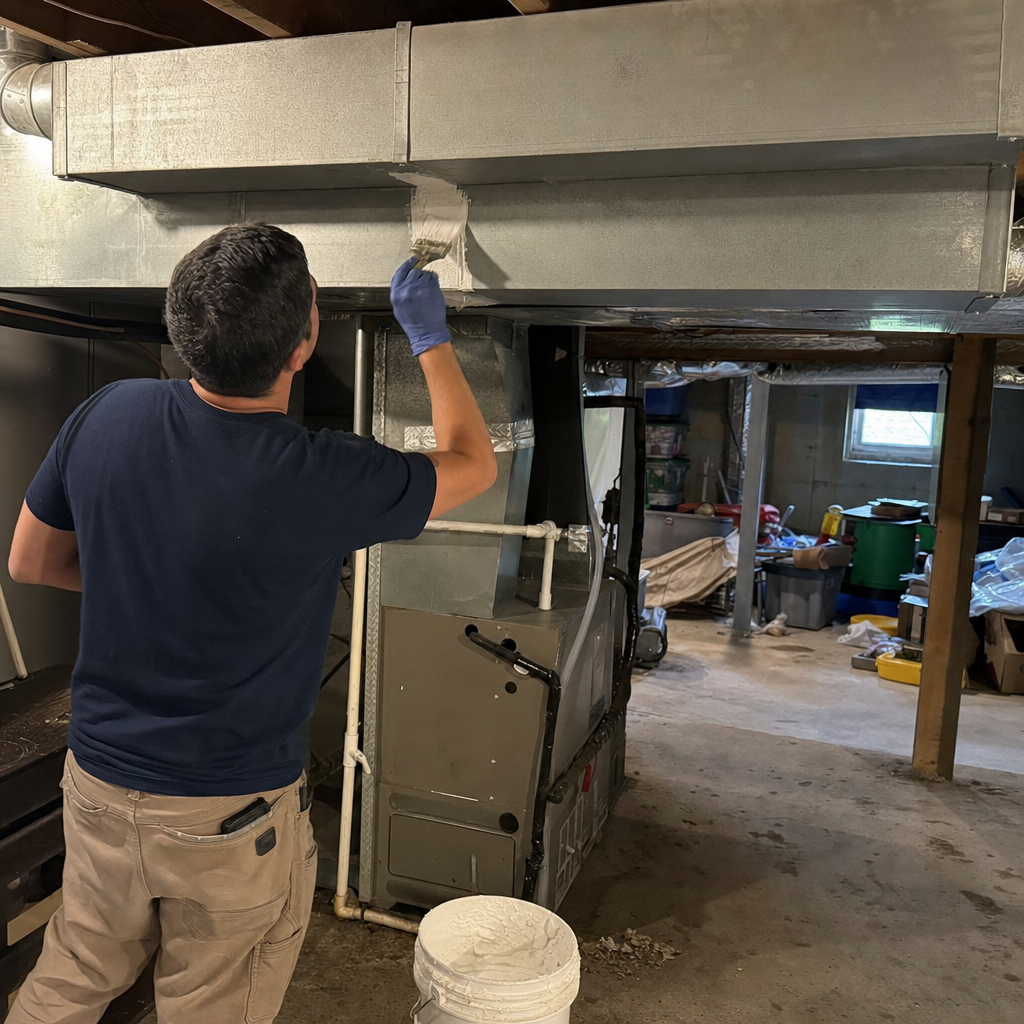
- Method chosen — mastic vs. Aeroseal vs. tape: Mastic brushed on by hand is the industry standard for accessible ducts. Aeroseal’s pressurized polymer injection costs more upfront but reaches leaks that no technician can get to physically — it’s worth considering when ductwork is buried in walls or inaccessible ceilings. Foil tape is appropriate only for specific joint types and isn’t a whole-home solution.
- Coastal climate wear: Virginia Beach’s proximity to the Chesapeake Bay and Atlantic coast means humidity levels that accelerate duct joint failure, rust on metal fasteners, and condensation damage on insulated flex lines. Homes within a mile of the water — Virginia Beach Oceanfront, Broad Bay, Linkhorn Park — often show duct degradation 5–10 years faster than inland properties. That’s a local factor most out-of-area pricing guides don’t account for.
How to Save on Duct Repair & Sealing in Virginia Beach
Bundle repair with cleaning. If your ducts haven’t been cleaned in several years, scheduling both in one visit is almost always cheaper than separate trips. You avoid a second service call, and the technician can spot damage during the cleaning that you’d otherwise miss until it becomes a bigger problem. At Anchor Air Duct Cleaning, Ronald Cooper does the assessment and the work on the same visit — nothing gets handed off.
Get an inspection before agreeing to Affordable Duct Repair & Sealing in Virginia, VA over a full replacement. Some contractors — particularly high-volume franchise operations — default to replacement when targeted repair is the right move. If a section of flex duct has pulled loose at the connection point, that’s a $150–$250 fix, not a $1,500 system overhaul. Knowing what you’re actually dealing with before anyone starts cutting saves real money.
Address it before cooling season. Virginia Beach summers push HVAC systems hard. Leaking ducts in June or July mean conditioned air escaping into attic space while your system runs longer to compensate. We consistently find that homeowners who address duct leaks in late winter or early spring — before the heat hits — spend less on the repair than homeowners who delay until a system breakdown forces the call.
Ask about diagnostic credit. Some contractors charge for a leak assessment separately from the repair. At Anchor Air Duct Cleaning, the goal is a free estimate — call (844) 668-1229 and Ronald Cooper can tell you upfront what you’re looking at before any work begins. No pressure, no mystery pricing.
Don’t chase the lowest coupon price. Virginia Beach has no shortage of $99 duct cleaning coupons that turn into four-figure upsells once a crew is inside your home. That pattern shows up in reviews constantly. With nearly 1,000 verified reviews at 4.9 stars, Anchor Air’s pricing is something you can cross-reference before you commit — look them up before you book.
Combine with dryer vent or HVAC cleaning. If multiple systems need attention, a single mobilization covers the travel and setup time. That efficiency gets passed along. One call to (844) 668-1229 can cover the scope and pricing for everything at once — no separate scheduling, no second invoice for a second truck.
Signs Your Virginia Beach Home Needs Duct Repair or Sealing
Most homeowners don’t discover duct leaks from a dramatic failure — they notice something feels off over time. Here’s what tends to show up in Virginia Beach homes before a repair call gets made:
- Rooms that never cool or heat evenly, even after HVAC service — particularly in two-story homes in the Great Neck and Alanton areas where upstairs rooms run hot in summer
- Higher-than-expected electric bills during peak cooling months (June through September in Virginia Beach), with no obvious explanation from the HVAC unit itself
- Musty or stale odors coming from registers — often a sign that conditioned air is mixing with unconditioned crawl space or attic air before it reaches the room
- Visible duct disconnections in the attic or crawl space — flex duct that has pulled away from a boot or collar is a complete air bypass, not a slow leak
- Excessive dust settling on surfaces within days of cleaning — a strong indicator that the return side is pulling in unconditioned, unfiltered air from the wrong place
- Condensation or moisture on duct surfaces in humid months — a particular concern in crawl space systems throughout the Virginia Beach area, where summer dew points regularly hit the mid-70s
A quick inspection by Ronald Cooper will tell you whether what you’re experiencing is a sealing issue, a cleaning issue, or both. Most of the homes we visit in Virginia Beach show some combination — and eleven years of doing this work exclusively means we can read a duct system quickly.
Why Virginia Beach Duct Systems Are Different
Virginia Beach isn’t a generic mid-Atlantic market when it comes to ductwork. The combination of coastal humidity, a large stock of homes built in the 1970s–1990s construction boom, and a crawl space foundation style common throughout the Tidewater region creates a specific set of problems that matter when you’re pricing a repair job.
The salt air accelerates metal corrosion — we regularly see fasteners and duct connections in oceanfront and Linkhorn Bay-area homes that have degraded years ahead of their inland counterparts. In Pungo and Princess Anne neighborhoods, older homes often still have original ductwork from when the area was developed, and flex duct that’s 25+ years old in a humid crawl space frequently shows inner liner separation — meaning air is flowing through collapsed liner, not the duct at all.
In newer construction — the townhome developments around Town Center and the Oceanfront resort corridor — ductwork is typically more accessible and better insulated, but connections can still fail under the thermal cycling that Virginia Beach summers produce. The HVAC system runs hard here from May through October. That’s not a complaint about the weather; it’s a fact that affects how quickly duct materials age and where failures tend to occur.
Ronald Cooper has worked in every type of Virginia Beach home over 11 years. That local pattern recognition is part of what makes an accurate estimate possible before any work starts. Visit our home page to see the full scope of what Anchor Air Duct Cleaning handles.
Repair vs. Replace: When Does Full Duct Replacement Make More Sense?
Repair and sealing is the right call for most Virginia Beach homeowners — but not all of them. Here’s a straightforward way to think about it:
- Repair and seal if: the duct system is less than 20 years old, damage is localized to a few sections, and the overall structure (hangers, connections, insulation wrap) is still sound.
- Partial replacement if: specific runs have collapsed, inner liner has separated in flex sections, or fiberboard duct has crumbled to the point where sealing compounds won’t adhere cleanly.
- Full replacement if: the system is original to a pre-1985 home, materials throughout have degraded past useful life, or the layout itself is inefficient for how the home is now used.
The honest answer is that full replacement is less common than some contractors suggest. In our experience across Virginia Beach homes, Duct Repair & Sealing Near Me in Virginia, VA resolves the performance problems in the majority of cases — and at a fraction of the replacement cost. The key is an accurate diagnosis first, which is exactly why Ronald Cooper does the assessment personally rather than delegating it to a crew member who’s going to read from a quote sheet.
FAQs — Duct Repair & Sealing Cost in Virginia Beach
How much does duct sealing cost in Virginia Beach, VA?
Mastic duct sealing for a typical Virginia Beach home runs $350–$600 for an accessible attic system, and $400–$900 for crawl space systems where access and coastal humidity have compounded the work. Aeroseal, which seals from the inside without physical access, runs higher — typically $1,200–$2,500 — but is the right choice when leaks are in areas a technician simply can’t reach. Call (844) 668-1229 for a free estimate specific to your home and system layout.
Is it worth sealing ducts in an older Virginia Beach home?
Yes — in most cases, significantly. The U.S. Department of Energy estimates that 20–30% of conditioned air is lost through leaky ducts in a typical home. In Virginia Beach, where HVAC systems run aggressively from late spring through early fall, that waste shows up in electric bills. A $500–$700 sealing job often pays for itself within two to three cooling seasons. The break-even calculus is harder only if the ductwork itself is at end of life — which is why the inspection step matters before committing to any method.
Can you repair just one section of ductwork, or does it have to be all at once?
Targeted, section-specific repair is both possible and common. $200–$500 per section covers most flex duct repairs in Virginia Beach homes. You don’t need to address the entire system if damage is localized — but Ronald Cooper will tell you honestly if what looks like one problem is actually a symptom of broader deterioration. Fixing one failed section in an otherwise degraded system is like patching one tire when the other three are also worn: it solves the immediate issue but sets up the next call.
How long does duct sealing last?
Mastic sealant, properly applied to clean duct surfaces, is considered a permanent seal — it doesn’t dry out or crack under normal conditions and typically lasts the life of the duct system. Foil tape, by contrast, can fail within 5–10 years, especially in humid environments like Virginia Beach crawl spaces. Aeroseal’s polymer coating is also designed for long-term durability. The key qualifier in all of this is “properly applied” — sealing over dirty or damaged duct material is the most common reason early failure happens.
Do I need duct cleaning before duct sealing?
In most cases, yes — and it’s not upsell language. Mastic won’t bond correctly to surfaces coated in dust, debris, or biological buildup, and sealing leaky ducts before cleaning them traps contaminants inside the system permanently. Doing both in one visit is the right sequence: clean first, seal second. At Anchor Air Duct Cleaning, that’s how Ronald Cooper approaches every combined job. The cost of bundling both services together is almost always less than scheduling them separately, and the result is cleaner, more airtight ductwork that actually performs the way it should. Call (844) 668-1229 to get a combined estimate — free, no obligation.
Written by Ronald Cooper, Owner and Lead Technician at Anchor Air Duct Cleaning Service Virginia, serving Virginia Beach since 2014. Pricing reflects the Virginia Beach market as of 2026. Anchor Air Duct Cleaning Service Virginia offers free estimates — call (844) 668-1229.
What Our Customers Say
"Found a disconnected run in the crawlspace while they were in there and told me about it rather than cleaning around it."
— Carmen Ramirez"Told me straight that our ducts were in decent shape and didn't need doing every year like the mailer companies claim."
— Raj Reddy"My wife's allergies had been bad in this house since we moved in. It's been two months since they did the ducts and it's noticeably better. Not a miracle, but real."
— Omar Aziz