
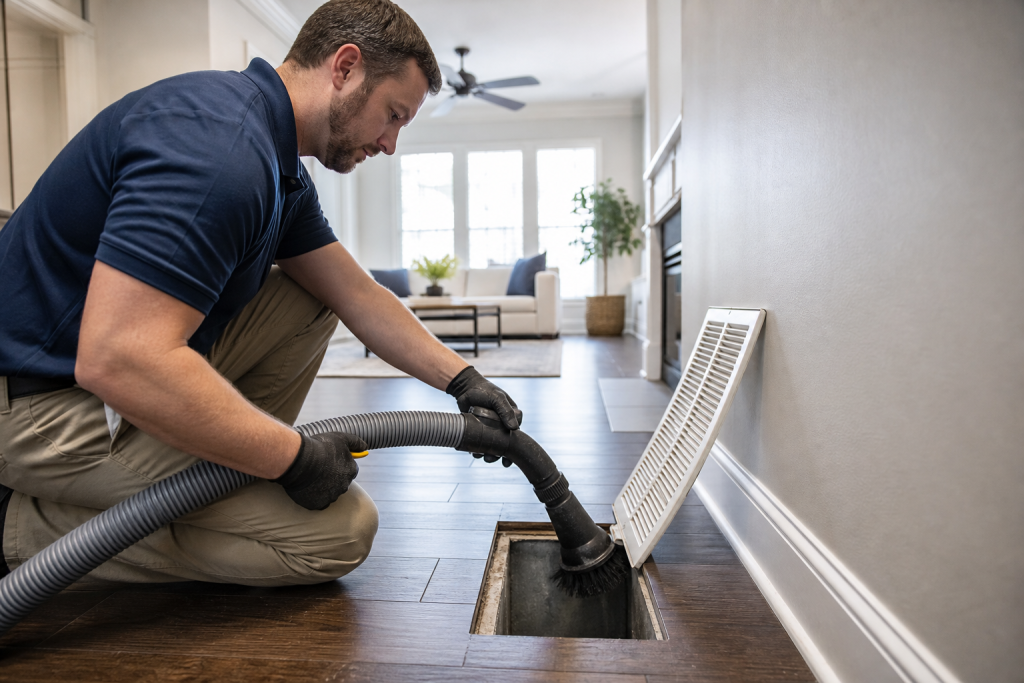
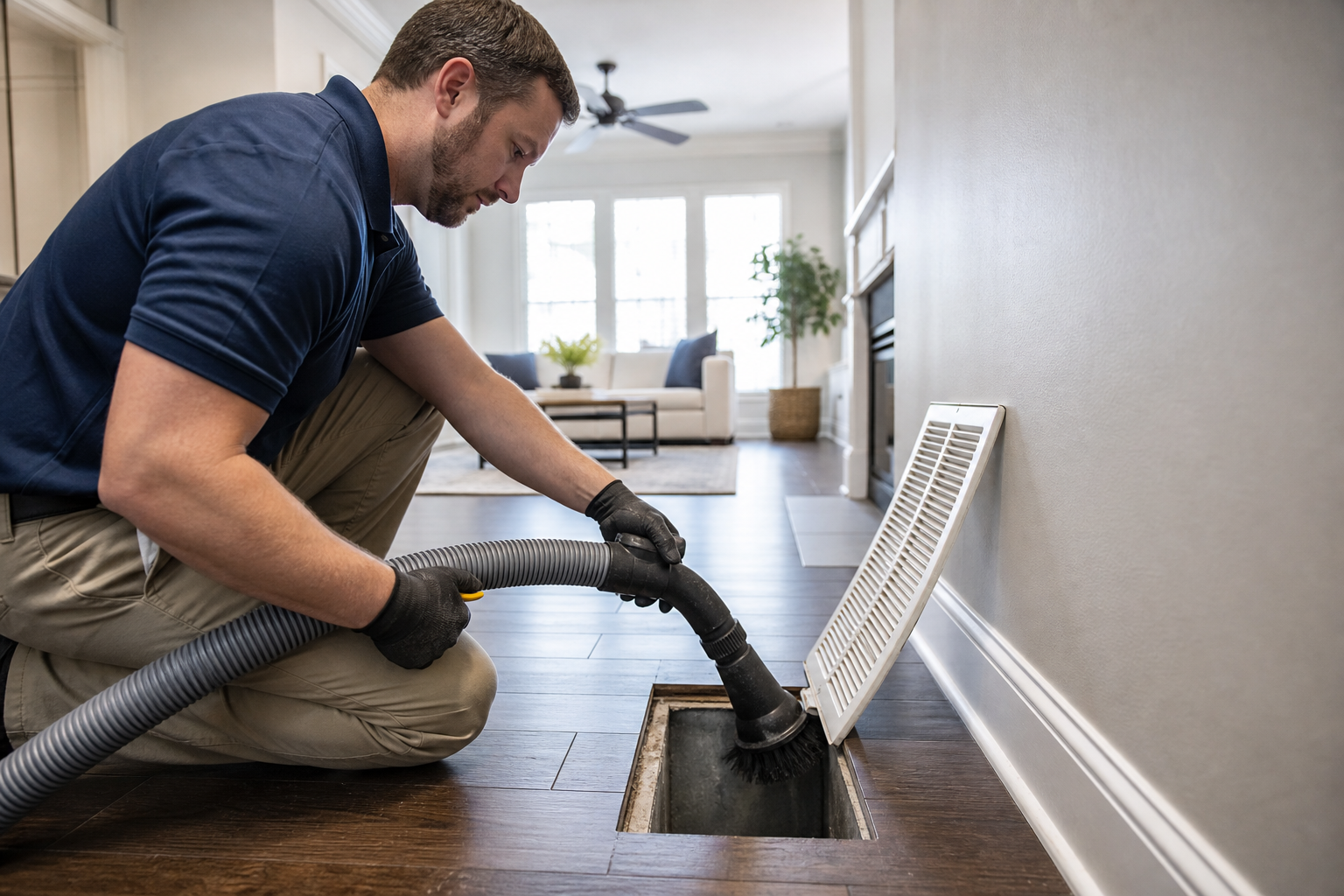
Emergency Air Duct Cleaning Near Me: What Virginia Beach Homeowners Should Do First
Emergency air duct cleaning in Virginia Beach should start with one non-negotiable step: shut off your HVAC system immediately. Whether you’re dealing with post-fire smoke, flood water intrusion, or visible mold in your air handler, running the system will redistribute contaminants through every room, turning a localized problem into whole-home contamination and adding thousands to your remediation costs. If you’re facing any of these scenarios right now and don’t want to risk making it worse, call us at (844) 668-1229 — we answer emergency calls and can walk you through the immediate steps while Ronald Cooper heads your way.
Here’s the mistake we see constantly in Virginia Beach homes: a homeowner smells smoke after a kitchen fire, opens every window, then flips the thermostat to “air out the house.” In our 11 years of duct work, we’ve arrived at jobs in neighborhoods like Great Neck and Kempsville where that single decision turned a $1,200 duct cleaning into a $6,000 full-system remediation with drywall replacement. The HVAC system doesn’t know the difference between clean air and contaminated air — it just moves whatever’s in your ducts.
Why Shutting Down Your HVAC Is Always Step One
The HVAC-off rule applies to every duct emergency we handle in Virginia Beach, and there’s no exception. Your duct system is a closed-loop distribution network. Once smoke particulate, floodwater, or mold spores enter that loop, the blower motor becomes a contamination pump.
Here’s what happens when you leave it running:
- Smoke and soot: Carbon particles smaller than 2.5 microns bypass standard filters and embed in porous duct lining. Every cycle pushes them deeper into fibers and out through vents.
- Flood water: Standing water in low-lying duct runs gets aerosolized by airflow, spreading bacteria and mold spores before visible water even recedes.
- Mold discovery: Disturbing active colonies with forced air releases spore concentrations that can colonize new areas within 24–72 hours in Virginia Beach’s humid coastal climate.
After you kill power at the thermostat, flip the breaker to the air handler if you can locate it safely. Don’t just set the system to “off” — a programmed schedule or smart-home automation can restart it without warning. Document that you took this step; insurance adjusters in Virginia Beach frequently ask for evidence of mitigation efforts to approve full remediation coverage.
In our experience across Virginia Beach’s mix of 1960s ranch homes in Princess Anne and newer construction in Red Mill, the homeowners who shut systems down immediately save 40–60% on total remediation costs compared to those who wait for a professional assessment.
Post-Fire Duct Contamination: Odor vs. Infiltration
Not all fire-related duct problems need the same fix, and knowing which you’re dealing with changes both the scope and the cost. Virginia Beach homeowners should understand the difference before calling any service.
Smoke odor (surface carbon deposits): This is what you smell when the fire was contained to one room and your HVAC wasn’t running during the event. Carbon molecules adhere to metal duct walls but haven’t penetrated porous flex duct lining or insulation. Professional cleaning with industrial agitation and HEPA extraction — we use Nikro and Rotobrush systems for this — typically resolves it in one thorough pass.
Soot infiltration: This occurs when the HVAC was operating during the fire or was turned on afterward. Soot particles are acidic and penetrate duct lining, insulation, and even the coil fins in your air handler. We see this regularly in Virginia Beach townhomes where shared walls allowed smoke migration before the system was shut down. Infiltration requires full system cleaning, often including lining replacement in flex duct sections and coil cleaning that standard maintenance crews can’t perform.
How to tell which you have before calling: wipe a white paper towel across the vent closest to the fire origin. Gray or black smearing that feels oily indicates soot infiltration. A dry, powdery residue with less color transfer suggests surface odor. Either way, don’t run the system — but infiltration means you’ll need a company with extraction equipment serious enough for remediation, not just maintenance cleaning.
We handled a job last month in Ocean Lakes where a homeowner’s dryer vent fire spread smoke into the return. They’d shut the system down within minutes, so we contained it to surface cleaning and coil treatment. Their neighbor two streets over ran the AC for three hours “to clear the smell” — same size house, same fire source, and they needed full flex duct replacement in the attic. Same emergency, different first response, vastly different outcome.
Flood and Water Intrusion: Virginia Beach’s 72-Hour Clock
Virginia Beach’s coastal geography creates specific flood risks that inland markets don’t face — storm surge, high water table, and the kind of driving rain that finds every gap in soffits and vent caps. When water enters your duct system, you’re racing a mold colonization window that starts the moment organic material gets wet.
Document before you dry: Take timestamped photos of standing water in vents, water stains on duct insulation, and any visible debris. Insurance adjusters serving Virginia Beach need proof of condition — not just “we cleaned it” — to approve replacement versus cleaning. We’ve seen legitimate claims denied because homeowners dried everything before documentation.
Drying vs. cleaning are different scopes: Industrial dehumidification and air movement can dry metal ductwork in 24–48 hours, but that doesn’t mean it’s clean. Floodwater in Virginia Beach carries sediment, bacteria, and in some areas near the Lynnhaven River, brackish residue that corrodes metal and feeds mold. Drying prevents further damage; cleaning removes what the water deposited. A company that only offers one or the other is selling you half a solution.
The humid subtropical climate here means even “minor” water intrusion in April through October can trigger mold growth before you notice musty airflow. We use Abatement Technologies HEPA containment and negative air machines on flood jobs specifically because standard cleaning equipment can’t safely handle biologically active contamination without cross-contaminating the home.
If you’re in a Virginia Beach flood zone — particularly Shadowlawn, parts of Thoroughgood, or anywhere east of Independence Boulevard — ask your duct company specifically whether they carry flood remediation equipment or just standard cleaning rigs. The answer tells you whether they understand the difference.
What to Ask When You Call for Emergency Service
Virginia Beach has no shortage of companies with “emergency” in their Google Business Profile. The difference between actual emergency capability and marketing language shows up in four specific questions:
- “What’s your actual response time, not your booking window?” — We aim to be on-site within hours for active contamination scenarios, because the HVAC-off rule only helps if assessment follows quickly.
- “Do you carry industrial extraction equipment, or just standard cleaning tools?” — Post-fire soot and flood bioload require HEPA-negative-air containment and industrial agitation systems. A Rotobrush maintenance rig won’t cut it for remediation.
- “Will you work directly with my insurance adjuster on scope and documentation?” — Companies that won’t itemize damage for insurance force you to become the project manager during an already stressful situation.
- “Is your lead technician the owner or a rotating employee?” — Ronald Cooper handles every emergency job personally. In 11 years, we’ve never sent a day-one hire to assess contamination someone will live with for years.
The last question matters more than people think. Emergency duct work isn’t just cleaning — it’s diagnostic. An experienced technician recognizes when duct lining is compromised beyond cleaning, when coil corrosion from saltwater exposure needs documentation for replacement, or when smoke damage has reached the blower assembly. That judgment call saves you from paying for cleaning that won’t solve the underlying problem.
Related services in Virginia Beach: if your emergency involves the full HVAC system, not just ducts, see our HVAC Cleaning in Norfolk page for scope details on coil, blower, and cabinet cleaning that complements duct remediation.
The Documentation You Need Before Any Cleaning Starts
Insurance reimbursement for emergency duct work in Virginia Beach requires proof of condition, not just proof of payment. We’ve worked with homeowners who paid out-of-pocket for legitimate remediation, then couldn’t recover costs because they had no baseline documentation.
Here’s what to create before the first tool gets unboxed:
- Timestamped photos: Every vent, the air handler, any visible contamination, and wide shots showing the room context. Include metadata or use a timestamp camera app.
- Written scope of damage: Your own notes on when the event occurred, when the HVAC was shut down, which rooms were affected, and any symptoms (odors, visible particles, water depth).
- Professional assessment in writing: Any company you call should provide a written scope of recommended work with line-item reasoning — not just a lump-sum quote. This becomes evidence if the adjuster questions necessity.
- Pre-cleaning air samples (for mold/flood): In Virginia Beach’s high-humidity environment, some insurers require spore count baselines to prove remediation was necessary versus precautionary.
We provide written scopes on every emergency call, and we’re familiar with documentation requirements for major insurers serving the Virginia Beach market. The 15 minutes spent on proper documentation typically saves weeks of back-and-forth with adjusters later.
One more Virginia Beach-specific note: if your home is in a designated flood zone and you carry NFIP coverage, ductwork remediation may fall under building coverage rather than contents. The documentation requirements differ, and starting work before understanding which coverage applies can complicate claims. We always ask about flood insurance status on emergency calls in Pungo, Blackwater, and other low-lying areas specifically for this reason.
The Bottom Line
Emergency air duct cleaning in Virginia Beach succeeds or fails in the first hour. Shut down your HVAC, document everything, know whether you’re facing odor or infiltration, and ask the right questions before hiring. The companies that rush to “clean” without assessing contamination type, insurance requirements, or equipment suitability are the same ones we get called behind to fix incomplete work.
Anchor Air Duct Cleaning Service Virginia has handled post-hurricane flooding, kitchen fire smoke migration, and mold discoveries across every Virginia Beach neighborhood from Alanton to Sandbridge. Ronald Cooper arrives as lead technician on every emergency call, with Rotobrush, Nikro, and Abatement Technologies equipment that matches the severity of the situation — not maintenance tools pressed into remediation service.
If you’re searching “emergency air duct cleaning near me” from a Virginia Beach home with active contamination, call (844) 668-1229 now. We’ll talk through your immediate steps, confirm response time, and schedule a free assessment. If your system is already off and documented, you’re ahead of most — let’s keep it that way.
Also serving Norfolk homeowners with the same owner-led approach: Air Duct Cleaning in Norfolk and Dryer Vent Cleaning in Norfolk.
Frequently Asked Questions
Emergency duct cleaning in Virginia Beach typically ranges from $800 for contained smoke odor in a single-zone system to $4,500+ for full remediation after flood infiltration with mold colonization. The wide range reflects whether you’re dealing with surface cleaning or lining replacement, how many zones the contamination reached, and whether HVAC components like coils and blowers need attention. Call (844) 668-1229 for a free, written estimate based on your specific situation — we don’t charge emergency fees just for responding quickly.
No — fan mode is equally dangerous as heating or cooling mode because the blower still circulates air through contaminated ducts. We’ve seen Virginia Beach homeowners turn fan-only circulation into whole-home soot distribution because they assumed “no heat” meant “no problem.” Any airflow through compromised ductwork spreads contamination. Shut the system completely and flip the breaker.
Metal ductwork can often be cleaned and sealed after flooding if addressed within 24–48 hours, but flex duct with waterlogged insulation almost always requires replacement — the insulation can’t be dried without mold risk, and it’s inaccessible for cleaning. In Virginia Beach’s humid climate, we recommend replacement for any flex duct that held standing water more than 24 hours. The cost difference between premature cleaning and necessary replacement usually favors getting the assessment right the first time.
Ask specifically about their extraction equipment brands and whether their lead technician handles emergency calls personally. Companies that name industrial systems like Nikro or Abatement Technologies and confirm owner/lead technician dispatch — not rotating crews — have invested in genuine emergency capability. Ask for a recent Virginia Beach reference with a similar scenario. Nearly 1,000 verified reviews at 4.9 stars — look them up before you book.
Written by Ronald Cooper, Owner & Lead Technician at Anchor Air Duct Cleaning Service Virginia, serving Virginia Beach since 2015.
Need Air Duct Cleaning Help?
Call Anchor Air Duct Cleaning Service Virginia — licensed & insured, here with fast after-hours help in Virginia.
(844) 668-1229