
Signs You Need Dryer Vent Cleaning in Virginia, VA — Before Your Dryer Fails Completely
The most reliable early signs you need dryer vent cleaning include weak airflow at your exterior vent flap, lint crusting around the outside termination cap, and a persistent musty smell in “dry” laundry — all of which appear months before clothes start taking two cycles to dry. In Virginia’s humid climate, these warning signals accelerate faster than in drier regions because moisture makes lint adhere to duct walls instead of blowing through. If you’re noticing any of these, Dryer Vent Cleaning in Virginia should be scheduled before the restriction becomes a fire hazard. Call (844) 668-1229 for a free assessment.

Why the “Classic” Warning Signs Arrive Too Late
By the time your dryer is taking two cycles to finish a load of towels, you’re not catching a problem early — you’re dealing with one that’s been building for months. Most online guides lead with the dramatic symptoms: burning smells, scorching hot dryer cabinets, clothes that come out still damp. Those are legitimate emergencies, but they’re also the final stage of a progressive failure.
We’ve spent 11 years providing Dryer Vent Cleaning services across Virginia, from the century-old Craftsman houses in Norfolk’s Ghent neighborhood to the tight townhome clusters in Virginia Beach’s Hilltop area. The pattern is consistent: homeowners who catch vent problems early save themselves the cost of premature dryer replacement and eliminate the fire risk before it materializes. The ones who wait until the “classic” symptoms appear are usually looking at a fully restricted duct, sometimes with water damage from condensation backup.
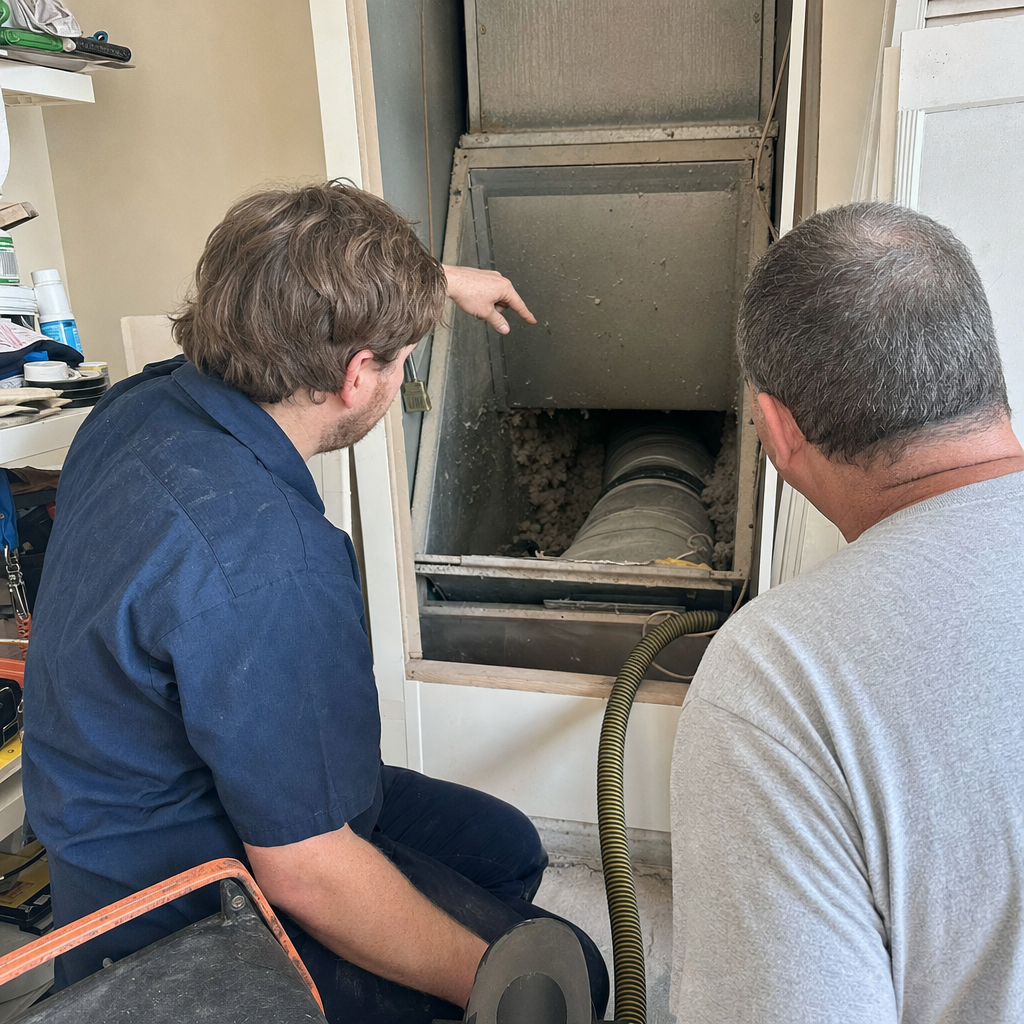
Ronald Cooper, our owner and lead technician, puts it this way: “If I can show you what I found, you can decide what it’s worth fixing.” That diagnostic approach — finding the problem before it finds you — is what separates a maintenance call from an emergency repair.
The Three Early Warning Signs Most Articles Skip
Weak or Intermittent Exterior Vent Flap Movement
Step outside while your dryer is running and watch the termination cap. The flap should lift steadily and hold open against the airflow. If it barely quivers, lifts only partway, or opens in weak pulses, you have a restriction somewhere in the line — and it’s been developing long enough to measurably reduce exhaust velocity.
This is the single most useful early indicator because it tests the entire system, not just the dryer itself. A dryer can appear to function normally while struggling against a partially blocked duct. The motor works harder, the heating element cycles longer, but the clothes still get dry — eventually. That “eventually” is costing you in energy bills and wearing down the machine.
In Virginia’s coastal neighborhoods, we see this frequently in homes where the vent path includes multiple 90-degree elbows to route through interior walls. A townhouse in Chesapeake’s Greenbrier area might have the laundry closet on an interior wall with the vent snaking through two elbows and fifteen feet of duct before reaching an exterior wall. Those bends are where lint accumulates first, and the exterior flap is where you see the evidence.
Lint Accumulating Faster at the Outside Cap
Some lint escape is normal — you’ll find a light accumulation around your exterior termination cap over time. But if you’re cleaning it off weekly or noticing a crusted ring that’s hard to brush away, your duct is expelling more lint than it should because it’s not flowing efficiently. The lint that should be carried through the full duct run is instead depositing near the end, where reduced airflow can’t push it clear.
We’ve pulled termination caps in Virginia Beach’s Red Mill Farms area that looked fine from ten feet away but were effectively sealed by a hardened lint crust mixed with humidity deposits. The dryer had been fighting that restriction for months. The homeowner’s only clue was that she’d started cleaning the outside cap more often — she recognized the symptom without realizing it was a symptom.
Musty Smell in “Dry” Laundry
Clothes that smell musty immediately after drying haven’t actually dried completely. In Virginia’s humid summers, a partially restricted vent that can’t expel heat efficiently creates condensation inside the duct. That moisture prevents full drying and gives bacteria the damp environment they need to produce that distinctive mildew odor.
This sign is particularly common in Hampton Roads from June through September, when outdoor humidity regularly exceeds 70%. A restricted vent in Arizona might simply run hot; the same restriction in Virginia runs wet. The moisture makes lint stick to duct walls instead of passing through, which accelerates blockage faster than in dry climates. We’ve seen ducts go from functional to fully restricted in a single summer because of this humidity-lint interaction.
How Lint Actually Builds Up — And Why the Path Matters
Lint doesn’t accumulate evenly along a duct run. It collects first at points of turbulence and direction change: the 90-degree elbow that turns from vertical to horizontal, the transition from rigid duct to flexible connector, the sag in a poorly supported flex line where lint settles like sediment.
Once a restriction starts at one of these points, the reduced airflow upstream allows more lint to deposit earlier in the run. The blockage grows backward toward the dryer, like plaque building in an artery. By the time you notice symptoms at the machine itself, the restriction has often reached back several feet.
This is why Virginia’s housing stock creates particular vulnerability:
- Townhouses and condos frequently route dryer vents through interior walls with multiple elbows to reach an exterior termination point — sometimes 20+ feet with two or three direction changes
- Colonial-style homes with centered laundry rooms may have vents running through finished basement ceilings or framed chases, adding length and bends
- Older Norfolk and Portsmouth homes often have retrofitted laundry setups where the vent path was designed for convenience, not optimal airflow
- Newer construction sometimes uses “booster fan” systems for long vent runs — and when those fans fail, lint accumulation accelerates dramatically
We use Rotobrush and Nikro systems — the same equipment HVAC professionals trust — specifically because they handle these complex Virginia configurations. A consumer-grade shop vacuum can’t navigate multiple elbows or generate the agitation needed to dislodge lint that’s hardened against duct walls.
Virginia-Specific Factors That Accelerate Vent Problems
Humidity and Condensation Cycling
Virginia’s climate creates a unique failure mode that dry-climate articles never mention: condensation-induced lint adhesion. When a partially restricted vent can’t maintain adequate exhaust temperature, the humid air inside the duct cools below its dew point. Water condenses on duct walls, lint particles hit that moisture and stick, and the resulting paste dries into a hard, layered deposit that’s much more difficult to remove than dry lint.
We’ve extracted deposits in Virginia Beach homes that resembled layered sedimentary rock — bands of lint and moisture deposits built up over multiple seasons. These require the mechanical agitation of professional-grade equipment; no homeowner with a brush kit from the hardware store is getting through that crust.
Local Wildlife and Exterior Termination Caps
Our coastal Virginia environment means birds, particularly starlings and house sparrows, find dryer vent terminations attractive nesting sites. Ronald Cooper regularly finds caps that are partially or fully blocked by nests or lint buildup that’s hardened into a crust. These caps look fine from a distance but are effectively sealed, and the dryer has been working against a closed vent for months.
We recommend exterior vent caps with proper bird guards — not the flimsy snap-on versions that clog with lint themselves, but integrated designs that maintain airflow while excluding wildlife. This is particularly important for homes near Virginia’s wetlands and marsh areas, where bird pressure is highest.
The “Simple Setup” That Isn’t
Homeowners frequently tell us their dryer vent is “just a short straight run” — but when we trace the actual path, we find it passes through a wall cavity with an undocumented elbow, or the “straight” flex line has sagged into a U-shape that traps lint. In Norfolk’s Larchmont neighborhood, we traced one “simple” vent through a floor system that added three hidden bends the homeowner never knew existed.
This is why our assessments include full path tracing with inspection cameras. You can’t clean what you can’t see, and you can’t see what you don’t look for.
What Professional Dryer Vent Cleaning Actually Involves
A thorough cleaning isn’t a vacuum hose stuck into the duct for a few minutes. Our process for Virginia homes includes:
- Full path inspection with camera systems to identify restrictions, damage, and configuration issues
- Mechanical agitation using Rotobrush systems that navigate elbows and dislodge adhered deposits
- Negative air extraction with Nikro equipment that captures dislodged material before it enters your home
- Exterior termination service — removing and cleaning the cap, checking for wildlife blockage, verifying proper flap operation
- Airflow verification with anemometer readings before and after to document improvement
For homes with the complex vent configurations common in Virginia’s townhouses and colonials, we may also use Abatement Technologies containment systems to protect finished spaces during the cleaning process.
When to Schedule vs. When to Call Urgently
| Symptom | Timeline | Action |
|---|---|---|
| Weak exterior flap movement | Schedule within 2-4 weeks | Standard cleaning assessment |
| Lint crusting at termination cap | Schedule within 1-2 weeks | Cleaning plus inspection for underlying restriction |
| Musty smell in dried laundry | Schedule within 1-2 weeks | Cleaning; may indicate condensation damage needing duct repair |
| Clothes requiring extended dry time | Schedule within 1 week | Priority cleaning; likely significant restriction |
| Burning smell or scorching heat | Same day — discontinue use | Emergency service; fire risk present |
FAQs
Most homeowners want to know How Much Does Dryer Vent Cleaning Cost? (2026 Price Guide) — Virginia, VA: in Virginia, cleanings typically range from $150 to $275 depending on vent length, accessibility, and whether the configuration requires specialized equipment for multiple elbows or hidden runs. Complex townhouse or colonial setups with long interior wall routing fall at the higher end. Call (844) 668-1229 for an exact quote — estimates are free.
DIY brush kits available at hardware stores can help with short, straight, easily accessible vent runs, but they’re ineffective for the multiple-elbow configurations common in Virginia homes and can’t remove hardened lint deposits. More importantly, improper DIY cleaning can compact lint into blockages or damage flexible duct connectors. For most Virginia homes, Affordable Dryer Vent Cleaning in Virginia, VA with Rotobrush or Nikro systems is the only thorough solution. Call (844) 668-1229 for a free assessment.
Virginia homeowners should schedule dryer vent cleaning every 12 to 18 months — more frequently if you have a long vent run with multiple elbows, a large household with heavy laundry volume, or if you’ve noticed any early warning signs. The humidity factor here means lint adheres faster than in drier regions, so the “every two years” guidance from national sources doesn’t apply as directly. Call (844) 668-1229 to set up a maintenance schedule.
Yes — discontinue use immediately and call (844) 668-1229. A burning smell from your dryer indicates lint ignition risk and requires same-day emergency service. Do not attempt to run another load. Nearly 1,000 verified reviews at 4.9 stars — look them up before you book.
Key Takeaways: Catching Dryer Vent Problems Early in Virginia
- The earliest warning signs — weak exterior flap movement, accelerated lint at the termination cap, musty laundry — appear months before dryers fail
- Virginia’s humidity creates a unique condensation-lint adhesion problem that accelerates blockage faster than in dry climates
- Local housing stock with interior-wall vent routing and multiple elbows traps lint more aggressively than short straight runs
- Professional-grade equipment (Rotobrush, Nikro) navigates complex configurations that DIY tools cannot address
- Annual to 18-month cleaning intervals are appropriate for Virginia’s climate and typical home configurations
If you’d rather have it looked at, Anchor Air Duct Cleaning Service Virginia offers the Best Dryer Vent Cleaning in Virginia, VA with a no-pressure assessment — call (844) 668-1229. Ronald Cooper handles your job personally — owner on-site, not an oversight call away. One company for cleaning, sealing, repair, and sanitizing — no referrals, no runaround.
Written by Ronald Cooper, Owner & Lead Technician at Anchor Air Duct Cleaning Service Virginia, serving Virginia, VA.