
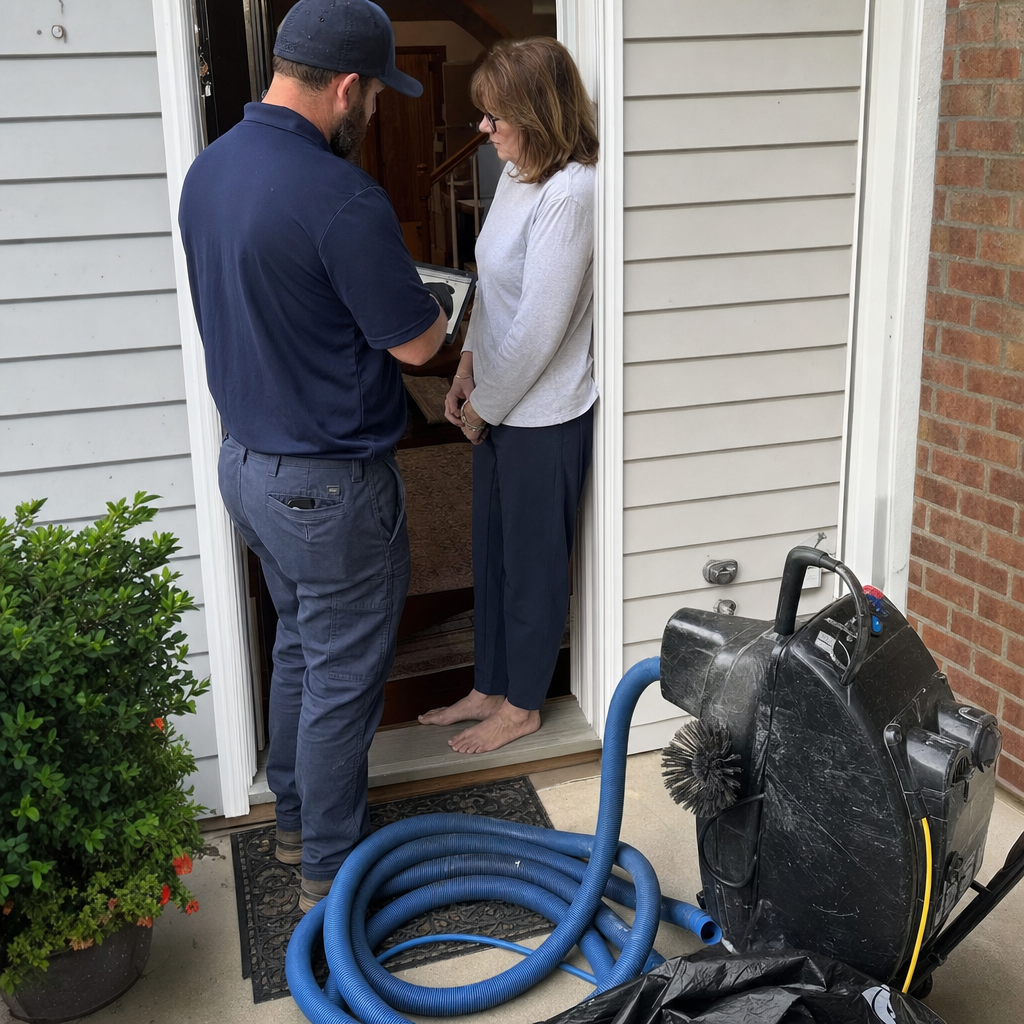
Air Duct Sanitizing Service in Virginia, VA — What It Actually Does and What You’re Paying For
Air duct sanitizing service in Virginia typically runs $250–$450 for residential systems and requires mechanical cleaning beforehand to be effective — spraying disinfectant on dirty ducts wastes your money. At Anchor Air Duct Cleaning Service Virginia, we apply EPA-registered antimicrobial treatment only after Rotobrush agitation and Nikro extraction have removed the debris layer, a sequence most coupon crews skip. Call (844) 668-1229 for a free estimate — Ronald Cooper handles your job personally as Lead Technician.
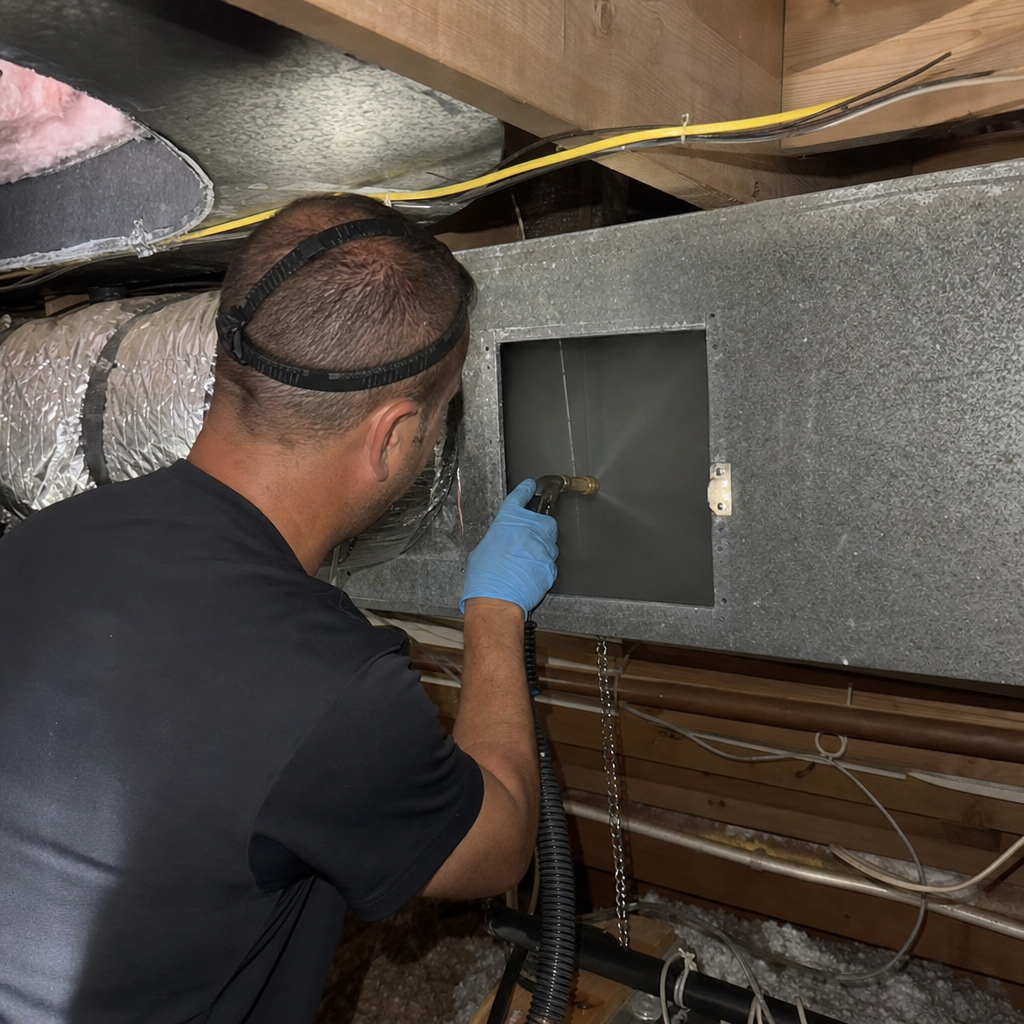
Virginia’s coastal humidity shapes everything we do here. From the older ranch homes off Shore Drive to the townhome clusters near Town Center, we’ve seen duct systems that sat through humid summers with compromised condensate drains or dirty evaporator coils. That moisture, trapped in fiberglass duct board or flex duct, creates the exact conditions where microbial growth finds a foothold. Sanitizing isn’t a luxury add-on in those cases — it’s a targeted response to a specific problem, but only when the ducts are actually clean first.
Why Sanitizing a Dirty Duct Fails — And Why Most Services Skip the Hard Part
Here’s the blunt version: spraying disinfectant onto a dust-coated duct surface is like spraying Lysol on a muddy countertop. The chemical hits the debris, not the metal or fiberglass beneath it, and you’ve accomplished nothing except separating yourself from your money. We’ve opened ducts in Virginia Beach homes where the previous “sanitizing” company fogged a vanilla-scented deodorizer into a system packed with ten years of accumulated skin cells, pet dander, and construction dust. The ducts smelled like vanilla-dusted filth for about three days.
The correct sequence is non-negotiable, and it’s where most competitors cut corners:
- Mechanical contact agitation with a powered brush system — we use Rotobrush equipment — to dislodge adhered debris from duct walls
- Negative-pressure source removal with a Nikro high-volume extraction unit to pull dislodged material out of the system entirely
- Visual verification that surfaces are clean enough for treatment to contact the actual duct material
- Application of EPA-registered antimicrobial product via fogging to all clean duct interiors, with proper dwell time before system restart
Ronald Cooper picked up his diagnostic approach through the trades program at Tidewater Community College before spending eleven years specializing exclusively in duct systems. His rule on every job: if I can show you what I found, you can decide what it’s worth fixing. That applies directly to sanitizing — we’ll show you the pre-cleaning camera footage so you understand why the two-step process matters.
What EPA-Registered Sanitizing Actually Means Versus Generic “Deodorizer” Treatments
The product matters as much as the preparation. Anchor Air Duct Cleaning Service Virginia uses EPA-registered antimicrobial solutions through our Abatement Technologies application equipment — the same containment and remediation-grade systems used in professional restoration work. “EPA-registered” isn’t marketing language; it means the product has undergone specific efficacy testing against labeled organisms and carries a registration number you can verify. Generic “deodorizer” or “freshener” sprays that some companies substitute have no such testing and no antimicrobial claim.
Our application process also differs from the quick-spritz approach:
| Step | What We Do | What Cheap Crews Often Do |
|---|---|---|
| Pre-treatment cleaning | Rotobrush agitation + Nikro extraction to bare surfaces | Skip or use weak vacuum only |
| Product selection | EPA-registered antimicrobial with labeled efficacy | Unregistered deodorizer or essential oil blend |
| Application method | Fogging to full duct interior with calculated coverage | Surface spray at accessible vents only |
| Dwell time | Product sits per manufacturer specifications before restart | Restart immediately — product never settles |
| Post-treatment verification | Visual confirmation of even coating | None |
We partner with Honeywell and Aprilaire for air quality components and Guardsman for protective treatments where applicable, but the sanitizing product itself is selected for its registration status and suitability for HVAC applications — not for a pleasant smell.
When Does a Virginia Home Actually Need Sanitizing — And When Doesn’t It?
This is where Ronald Cooper’s kitchen-table honesty comes in. Not every duct system needs sanitizing, and we’ll tell you when it doesn’t.
Sanitizing is warranted when:
- Visible microbial growth has been professionally remediated and you need post-remediation treatment of remaining surfaces
- Your system experienced water intrusion from a clogged condensate line, flooding, or coil overflow — common in Virginia’s humid summers
- You’ve completed mold remediation and need documented antimicrobial treatment as part of clearance
- A family member has specific immunocompromise and your HVAC specialist recommends it as part of a broader protocol
Sanitizing does NOT:
- Replace proper mold remediation — active growth above 10 square feet requires abatement, not a spray treatment
- Fix the moisture source — if your coil is still dripping or your duct insulation is wet, sanitizing is temporary theater
- Substitute for regular filter changes — a MERV 8 filter changed quarterly does more for routine air quality than annual sanitizing
- Remove particulate matter — that’s extraction’s job, and sanitizing without it is the muddy-countertop problem again
We’ve inspected systems in Norfolk’s historic neighborhoods where century-old Craftsman houses have been retrofitted with ductwork that sweats in crawl spaces. The fix isn’t sanitizing — it’s sealing and insulating the duct, maybe adding a dehumidifier. We’d rather sell you the right service than the easy add-on.
What Does Air Duct Sanitizing Service Cost in Virginia?
Pricing depends on system size, accessibility, and whether we’re sanitizing as part of a full cleaning or as a standalone post-remediation treatment. For a detailed breakdown, see our How Much Does Air Quality & Sanitizing Cost? (2026 Price Guide) — Virginia, VA. These ranges reflect what we’ve charged across Virginia Beach, Norfolk, Chesapeake, and the broader Hampton Roads area over the past two years:
| Service Component | Price Range |
|---|---|
| Residential duct sanitizing (with full cleaning package) | $250 – $350 |
| Residential duct sanitizing (standalone, post-remediation) | $300 – $450 |
| Commercial/light industrial sanitizing per air handler zone | $400 – $650 |
| Coil and pan sanitizing (add-on to duct service) | $125 – $195 |
| Dryer vent sanitizing (where moisture issues exist) | $85 – $150 |
We don’t quote by the vent count — that’s a coupon-company gimmick that hides the real price until they’re in your hallway. Ronald Cooper assesses your actual system layout, access points, and whether the ductwork is even cleanable before we discuss sanitizing at all. Call (844) 668-1229 — estimates are free, and we’ll show you what we find before you decide.
How Anchor’s Process Differs From Franchise Crews
The equipment gap is real. Most competitors in the Virginia market run consumer-grade shop vacuums with long hoses, or they rent Rotobrush machines without understanding brush selection for different duct materials. Our Nikro and Abatement Technologies systems are purpose-built for source removal and containment — industrial extraction capacity, HEPA filtration on exhaust, and the ability to maintain negative pressure throughout the job.
But the bigger difference is who runs it. Ronald Cooper grew up off Tidewater Drive in Norfolk, lives in Virginia Beach with his wife and teenage son, and fishes off the Lesner Bridge when he’s not working. He’s not managing from an office — he’s the one in your attic, your crawl space, or your mechanical room, running the equipment himself. Nearly 1,000 verified reviews at 4.9 stars reflect what happens when the most experienced person in the company does the actual work, not a day-one hire working from a script.
Eleven years of duct work, zero sidelines — this is all we do. One company for Air Quality & Sanitizing, cleaning, sealing, and repair — no referrals, no runaround.
What to Ask Any Company Before You Book Sanitizing
If you’re searching for Air Quality & Sanitizing Near Me in Virginia, VA and comparing providers, these questions separate actual technicians from phone-room operations:
- Do you mechanically clean the ducts before applying sanitizer, or is fogging the only step? (If they don’t clean first, keep looking.)
- Is your antimicrobial product EPA-registered, and what’s the registration number? (They should know this immediately.)
- What dwell time do you allow before restarting the HVAC system? (Under ten minutes suggests they’re not following label directions.)
- Who performs the work — an owner-technician or a rotating crew? (Experience level varies enormously in this trade.)
- Can you show me pre- and post-cleaning footage? (Camera verification is standard for competent operators.)
We’ve lost jobs to cheaper quotes and won them back six months later when the customer realized they’d paid for scented air in dirty ducts. We use Rotobrush and Nikro systems — the same equipment HVAC professionals trust — and we don’t apologize for charging what thorough work actually costs.
FAQs
Residential air duct sanitizing in Virginia typically costs $250–$450 depending on system size and whether it’s bundled with mechanical cleaning or performed as standalone post-remediation treatment. Call (844) 668-1229 for a free estimate — we’ll assess your actual system before quoting.
No — sanitizing treats clean surfaces to inhibit future microbial growth, but it does not remove active mold colonization, which requires professional remediation for areas larger than 10 square feet. If Ronald Cooper finds active growth during inspection, he’ll tell you straight that you need remediation first, not a spray treatment.
Yes — Virginia’s summer humidity makes post-water-damage sanitizing specifically warranted when moisture has contacted duct interiors, particularly fiberglass duct board or flex duct that can retain dampness. The treatment must follow proper drying and cleaning, and the moisture source must be fixed first or you’re treating symptoms, not causes.
Most residential sanitizing applications take 45–90 minutes depending on system size, with EPA-registered products requiring 15–30 minutes dwell time before HVAC restart to achieve labeled efficacy. We account for this in scheduling — you’re not sitting in a hot house wondering when it’s safe to turn the air back on.
Ready to Get Your Ducts Properly Assessed?
Don’t pay for theatrical fogging in dirty ducts. If you want the Best Air Quality & Sanitizing in Virginia, VA and you’re anywhere in Hampton Roads, call (844) 668-1229 for a free estimate. Ronald Cooper will inspect your system personally, show you what he finds, and recommend sanitizing only if your ducts are actually clean enough to benefit from it. No upsell pressure, no jargon — just eleven years of specialized experience applied to your specific system.
Written by Ronald Cooper, Owner & Lead Technician at Anchor Air Duct Cleaning Service Virginia, serving Virginia, VA.
What Our Customers Say
"Found a disconnected run in the crawlspace while they were in there and told me about it rather than cleaning around it."
— Carmen Ramirez"Told me straight that our ducts were in decent shape and didn't need doing every year like the mailer companies claim."
— Raj Reddy"My wife's allergies had been bad in this house since we moved in. It's been two months since they did the ducts and it's noticeably better. Not a miracle, but real."
— Omar Aziz