
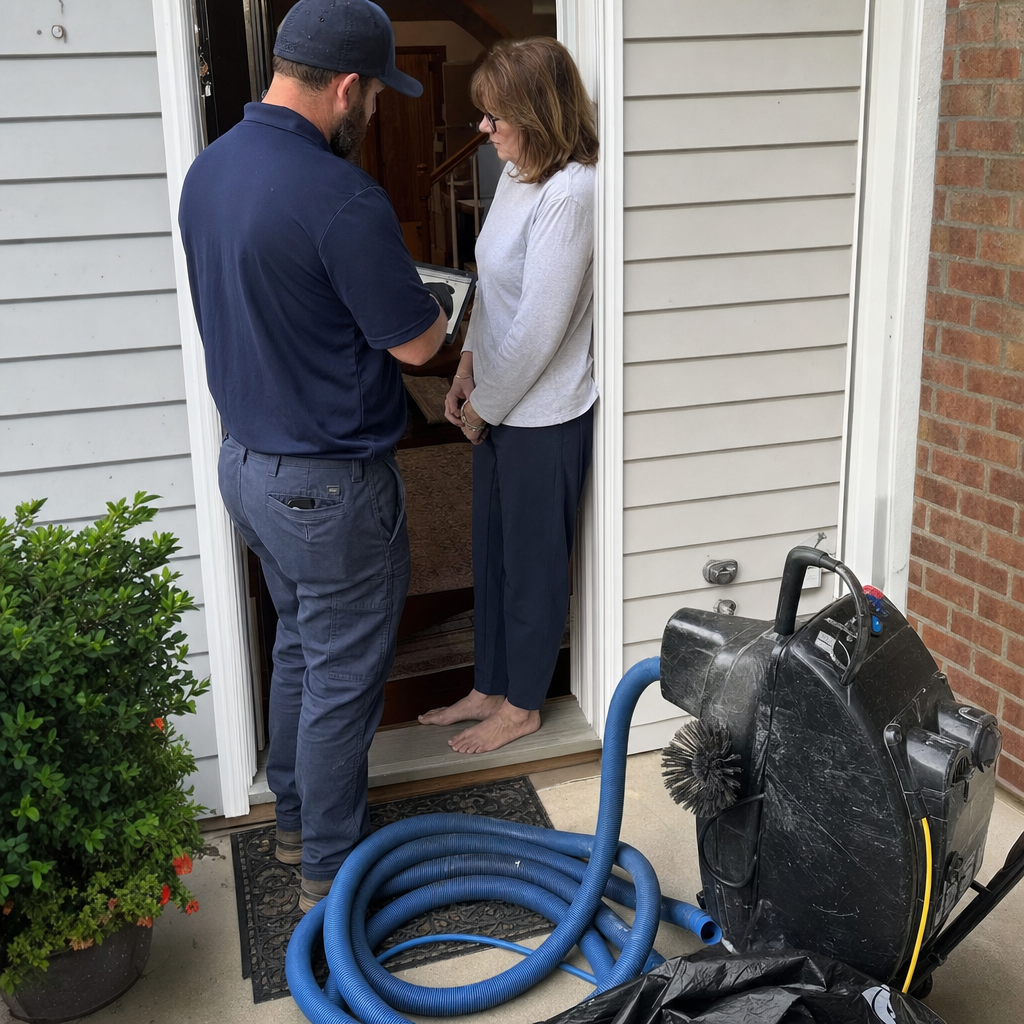
How Much Does Air Duct Cleaning Cost in Virginia Beach?
Air Duct Cleaning in Virginia Beach typically costs between $300 and $650 for a standard residential home, with most single-family jobs landing around $400–$500 depending on system size, duct count, and access conditions. Larger homes, heavily contaminated systems, or properties near the oceanfront — where salt air accelerates buildup inside HVAC components — will sit toward the higher end of that range or beyond.
The wide spread you’ll see advertised online — from $99 coupons to $900 quotes — reflects genuine differences in equipment, scope, and technician experience, not just company markup. Knowing what drives the number up or down is the most useful thing you can read before booking anyone.
Air Duct Cleaning Cost Breakdown (2026)
Here’s how pricing breaks down across the most common service types we handle in Virginia Beach homes and commercial properties. These ranges reflect the real 2026 market — not national averages imported from inland markets that don’t deal with Virginia Beach’s coastal humidity and salt-laden air.
| Service | Typical Price Range | Notes |
|---|---|---|
| Residential Air Duct Cleaning (up to 10 vents) | $300 – $425 | Smaller homes, townhomes, condos near Oceanfront or Hilltop |
| Residential Air Duct Cleaning (11–20 vents) | $425 – $575 | Most standard single-family homes in Virginia Beach |
| Residential Air Duct Cleaning (21+ vents) | $575 – $800+ | Larger homes in Chesapeake Beach, Red Mill, or Great Neck areas |
| Dryer Vent Cleaning | $100 – $175 | Often bundled; longer vent runs cost more |
| HVAC Unit Cleaning (evaporator coil, blower) | $150 – $300 | Frequently needed when ducts haven’t been serviced in 5+ years |
| Air Sanitizing Treatment | $75 – $150 | Applied after cleaning using Honeywell or Guardsman products |
| Duct Repair & Sealing | $200 – $600+ | Depends on extent of damage; common in older Virginia Beach neighborhoods |
| Commercial Duct Cleaning | $500 – $2,500+ | Priced by system complexity and square footage |
A few things worth calling out here. First, the $99-and-up coupon deals you’ll see circulating in Virginia Beach typically cover a fixed number of vents — often 10 — and don’t include the return air trunk, the blower compartment, or any mold-related treatment. By the time a crew from a national franchise finishes upselling, homeowners in neighborhoods like Kempsville or Indian River routinely tell us they paid more than a straightforward quote from a specialized company would have cost. Second, these ranges assume a normally accessible system. Homes with crawl-space ductwork — common in Virginia Beach’s older stock housing — or systems with collapsed flex duct will add time and cost.
What Affects Air Duct Cleaning Pricing in Virginia Beach
- Number of vents and system size: This is the single biggest variable. A 1,200-square-foot condo near the Oceanfront with 8 supply vents and 2 returns is a fundamentally different job than a 3,500-square-foot home in the Strawbridge or Dam Neck corridor with 24 vents across two HVAC systems. Every additional vent adds time, and time drives cost.
- Coastal salt air and humidity accumulation: Virginia Beach’s proximity to the Atlantic and the Chesapeake Bay creates indoor air conditions that don’t exist in most U.S. markets. Salt particulates migrate into HVAC systems — especially in homes east of Independence Boulevard — and combine with the region’s above-average humidity to accelerate microbial growth inside ducts. Systems in these zip codes often require more aggressive agitation tools and longer suction time to address what has caked onto duct walls.
- How long since the last cleaning (or whether it’s ever been done): A system that hasn’t been touched in 8–10 years — which is common in homes built during Virginia Beach’s 1980s–1990s growth period in areas like Landstown and Princess Anne — will take significantly longer to clean than one serviced 3–4 years ago. Thick debris compaction means more mechanical agitation passes with Rotobrush equipment and longer Nikro extraction time.
- Duct material and configuration: Flexible duct (flex duct), sheet metal, and fiberboard each behave differently under cleaning tools. Virginia Beach has a large stock of homes with flex duct, which is prone to sagging, tearing, and internal lining deterioration. If a technician discovers compromised flex during cleaning, duct repair or replacement adds to the scope — and the price.
- Additional services bundled vs. standalone: Cleaning the ducts without cleaning the HVAC unit itself is like washing your car and leaving the engine filthy. The blower wheel and evaporator coil are where a significant share of particulate accumulates. Bundling HVAC unit cleaning with duct cleaning is typically more cost-effective per service than scheduling them separately — and it’s the approach Ronald Cooper recommends on most jobs where the HVAC hasn’t been serviced recently.
- Access difficulty and crawlspace situations: Many Virginia Beach homes in older sections of the Bayside or Seatack neighborhoods were built on crawlspaces with ductwork running underneath. Technicians working in a confined crawlspace — with insulation, vapor barriers, and limited mobility — take longer and face more physical demands than a standard attic or basement system. That additional labor is reflected in the quote.
Is Air Duct Cleaning Worth the Cost in Virginia Beach?
For Virginia Beach homeowners specifically, the answer is yes — and the regional climate is a big reason why. Homes in coastal Virginia spend more months of the year running air conditioning than homes in most of the country. That means your system is cycling air through your duct network for longer cumulative hours, pulling in the particulates, pollen, and humidity that Virginia Beach generates in abundance. A properly cleaned and sealed system runs more efficiently, distributes air more evenly, and doesn’t circulate a season’s worth of accumulated debris every time the thermostat kicks on.
We’ve cleaned duct systems in Virginia Beach homes — particularly in neighborhoods like Chesapeake Beach and Bay Colony — where homeowners noticed a meaningful difference in how the system performed after cleaning: better airflow to rooms that always seemed underserved, less dust settling on surfaces, and in some cases lower utility bills once a clogged system was running freely again. Those aren’t promises — they’re patterns we’ve observed across 11 years of duct work in this market.
For anyone who has had a bad experience with a discount crew and is skeptical, that skepticism is reasonable. A crew armed with a consumer-grade shop vacuum isn’t going to produce the same result as a job done with Rotobrush and Nikro industrial extraction — the equipment difference is real, and it shows in the finished state of the system.
How to Save on Air Duct Cleaning Without Cutting Corners
There’s a meaningful difference between saving money and buying a cheap service that doesn’t actually clean your system. Here’s how Virginia Beach homeowners get the most value from the Best Air Duct Cleaning in Virginia, VA:
- Bundle services in a single visit. Scheduling duct cleaning, dryer vent cleaning, and HVAC unit cleaning at the same time is almost always more efficient than separate trips — and some companies, including Anchor Air Duct Cleaning, can build a combined scope that reflects the reduced mobilization time. Call (844) 668-1229 to ask what a bundled job would look like for your home.
- Get a real walkthrough estimate, not a per-vent phone quote. A technician who has walked your system — seen the duct material, counted actual vents, identified access points — gives you a quote that won’t expand when they arrive. A flat “per vent” phone quote from a company that hasn’t seen your system is frequently the setup for an on-site upsell.
- Don’t wait until there’s a problem. Reactive cleaning after a mold discovery or HVAC failure is almost always more expensive than maintenance cleaning on a regular schedule. Every 3–5 years is the general guidance for Virginia Beach homes; homes with pets, smokers, or known water intrusion history should be on the shorter end of that range.
- Verify the equipment before you book. Ask any company you’re considering what equipment they use. If the answer is vague or doesn’t include names like Rotobrush, Nikro, or a comparable industrial-grade system, that’s a signal about the quality of result you should expect. The equipment cost is why a legitimate cleaning costs more than $99.
- Ask about free estimates. Anchor Air Duct Cleaning offers free estimates — we’d rather give you an honest quote than have you guess at a number. Call (844) 668-1229 and Ronald Cooper or his team will walk through what your job actually involves before you commit to anything.
FAQs — Air Duct Cleaning Cost in Virginia Beach
How much does air duct cleaning cost in Virginia Beach in 2026?
Most Virginia Beach homes pay between $300 and $650 for Air Duct Cleaning Near Me in Virginia, VA, with the average single-family job landing around $400–$500. Smaller condos or townhomes near the Oceanfront area typically start around $300, while larger homes in neighborhoods like Red Mill or Great Neck with dual HVAC systems can reach $700–$800 or more. Call (844) 668-1229 for a free estimate specific to your home’s size and system.
Why are some companies advertising $99 duct cleaning in Virginia Beach?
The $99 price almost always covers a limited number of vents — usually 8–10 — and excludes the return air system, blower compartment, and any real agitation equipment. In our experience, homeowners who book these deals in Virginia Beach frequently report that the final invoice was $400–$600 anyway, after vents beyond the base count and “recommended” add-ons. A transparent, equipment-serious job quoted honestly upfront is almost always the better value. Call (844) 668-1229 and we’ll tell you exactly what your job will cost before anyone shows up.
How often should Virginia Beach homeowners clean their air ducts?
How Often to Clean Air Ducts? (Virginia, VA) — every 3–5 years is the standard guidance for most homes, but Virginia Beach’s coastal humidity and longer AC-running seasons push toward the shorter end of that range. Homes with pets, a recent renovation, visible mold near vents, or a history of water intrusion should be cleaned sooner. If you’re not sure when your system was last cleaned — or if it ever was — that’s typically enough reason to schedule a cleaning now.
Is it cheaper to repair or replace damaged ductwork in Virginia Beach?
Spot repair and sealing — the kind of targeted work Ronald Cooper handles directly — typically runs $200–$600 depending on how many sections need attention. Full duct replacement is a significantly larger investment, often $2,000–$5,000 or more for a whole-home system. In most cases we encounter in Virginia Beach, the damage is localized: a collapsed flex duct section, disconnected joints behind a wall, or deteriorated seals at registers. Repair almost always makes financial sense unless the entire duct system is in advanced deterioration. We’ll tell you honestly which situation you’re in.
Does air duct cleaning help with allergies in Virginia Beach?
A professionally cleaned duct system — one where debris is actually extracted using industrial-grade equipment rather than just disturbed and redistributed — removes accumulated pollen, dust mite debris, pet dander, and mold spores from the air distribution path. Virginia Beach’s pollen seasons are long and intense, and the city’s humidity supports dust mite populations at levels most inland markets don’t see. Homeowners with allergies who invest in a thorough cleaning, followed by a Honeywell or Aprilaire filtration upgrade, consistently report fewer airborne triggers cycling through their living spaces. That’s not a medical claim — it’s a pattern we’ve seen across hundreds of Virginia Beach jobs over 11 years.
Why Virginia Beach Homeowners Choose Anchor Air Duct Cleaning
There are a lot of options in the Virginia Beach market — national franchise crews, general HVAC companies that offer duct cleaning as a secondary service, and low-bid operators who show up with inadequate equipment. Here’s the straightforward case for working with Anchor Air Duct Cleaning Service Virginia instead.
Ronald Cooper doesn’t manage crews from an office. He’s the lead technician on every job — the most experienced person in the company is the person working on your system. After 11 years of exclusive focus on duct and HVAC cleaning in Virginia Beach and across Air Duct Cleaning in Virginia, he has worked through every system configuration this market produces: coastal homes with salt-compromised components, crawlspace-run flex duct in older Seatack and Bayside properties, dual-zone systems in newer Great Neck construction, and everything in between.
The equipment is industrial grade. Rotobrush and Nikro systems aren’t consumer tools with professional branding — they’re what serious duct cleaning operations use when the goal is actually clean ductwork, not a service receipt. Abatement Technologies containment equipment means debris comes out of your system, not into your living space during the cleaning process.
Nearly 1,000 verified reviews at 4.9 stars doesn’t happen by accident. It reflects what happens when the same experienced person shows up, uses the right equipment, and doesn’t treat the job as a loss leader for upsells. Look the reviews up before you book anyone — that’s exactly the kind of due diligence we’d encourage you to do.
From our home base in Virginia Beach, we handle air duct cleaning, dryer vent cleaning, HVAC cleaning, duct repair and sealing, and air sanitizing — one call, one company, no referrals to a subcontractor when the job gets complicated. If you want to know what your specific job will cost, the fastest way to find out is to call.
Ready for a Free Estimate? Call Anchor Air Duct Cleaning
If you’re trying to figure out what air duct cleaning will actually cost for your Virginia Beach home or commercial property, skip the guessing and call (844) 668-1229. Ronald Cooper and the team at Anchor Air Duct Cleaning Service Virginia offer free, no-pressure estimates — we’ll talk through your system, give you a real number, and answer any questions you have before anything is scheduled. Nearly 1,000 Virginia Beach customers have trusted us with their systems; we’d be glad to earn that same trust from you.
- Phone: (844) 668-1229
- Free estimates — no obligation, no vague quotes
- Owner Ronald Cooper on every job as lead technician
- 11 years serving Virginia Beach exclusively in duct and HVAC cleaning
- 962 verified reviews, 4.9-star average — look them up
Pricing reflects the Virginia Beach market as of 2026. Anchor Air Duct Cleaning Service Virginia offers free estimates — call (844) 668-1229.
Written by Ronald Cooper, Owner and Lead Technician at Anchor Air Duct Cleaning Service Virginia, serving Virginia Beach since 2013.
What Our Customers Say
"Found a disconnected run in the crawlspace while they were in there and told me about it rather than cleaning around it."
— Carmen Ramirez"Told me straight that our ducts were in decent shape and didn't need doing every year like the mailer companies claim."
— Raj Reddy"My wife's allergies had been bad in this house since we moved in. It's been two months since they did the ducts and it's noticeably better. Not a miracle, but real."
— Omar Aziz